Authentic Divination by AI
Based on traditional yarrow stalk divination algorithms, generating hexagrams with clear interpretations.
3000 Years of Wisdom Meets AI.
Don't just divine—take action.
AI trained on 200,000+ characters of I Ching texts
transforms your concerns into concrete action plans.
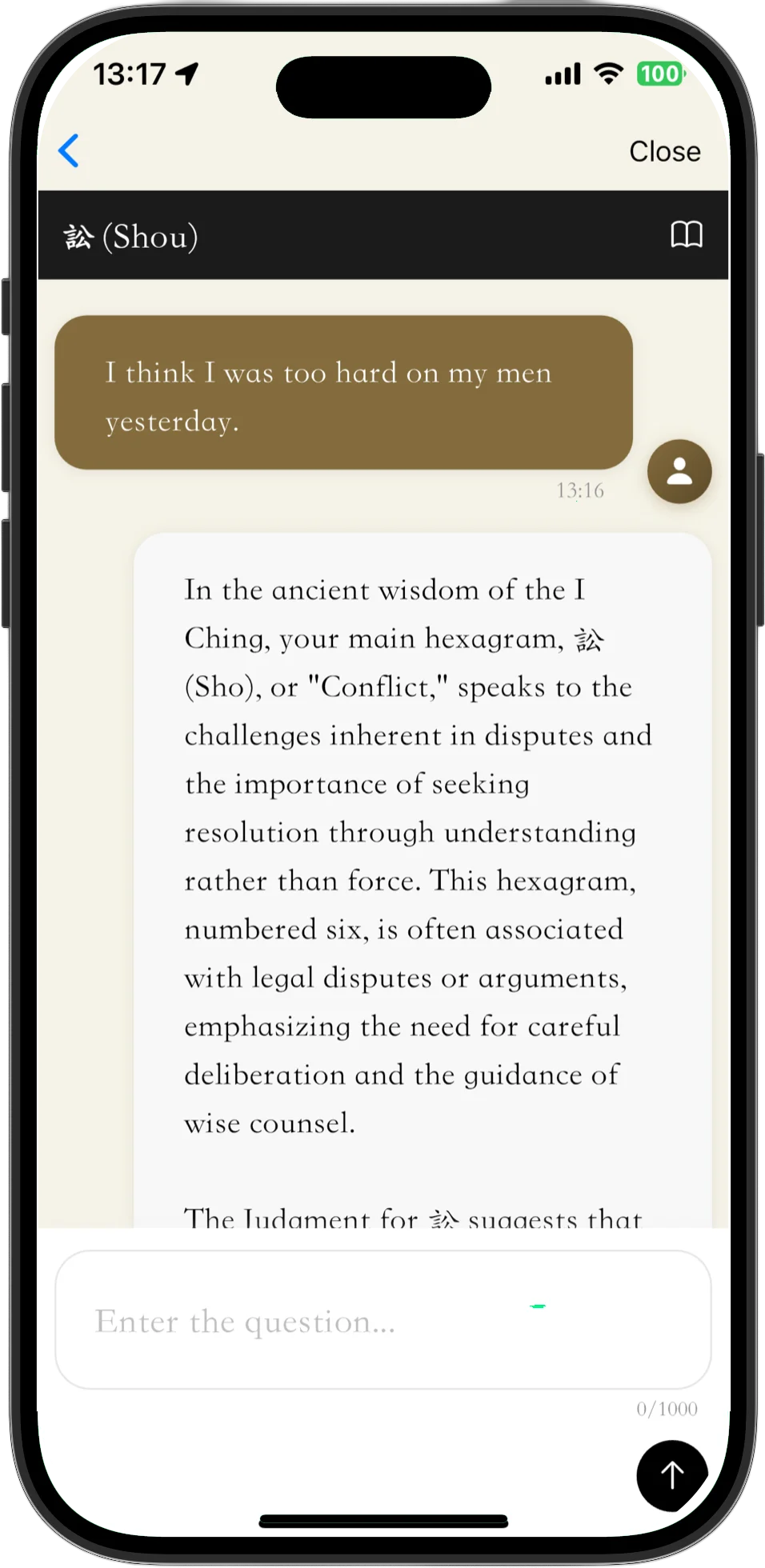
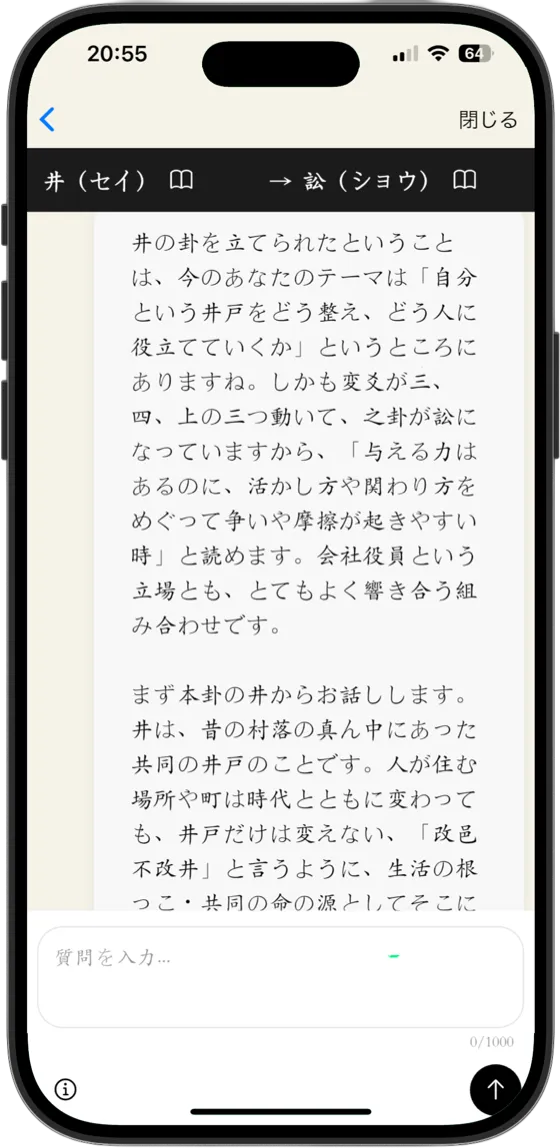
The I Ching (also known as Yi Jing or the Book of Changes) is the world's oldest book of wisdom, originating in China approximately 3,000 years ago. It remains one of the most influential texts in Eastern philosophy, consulted for guidance across millennia.
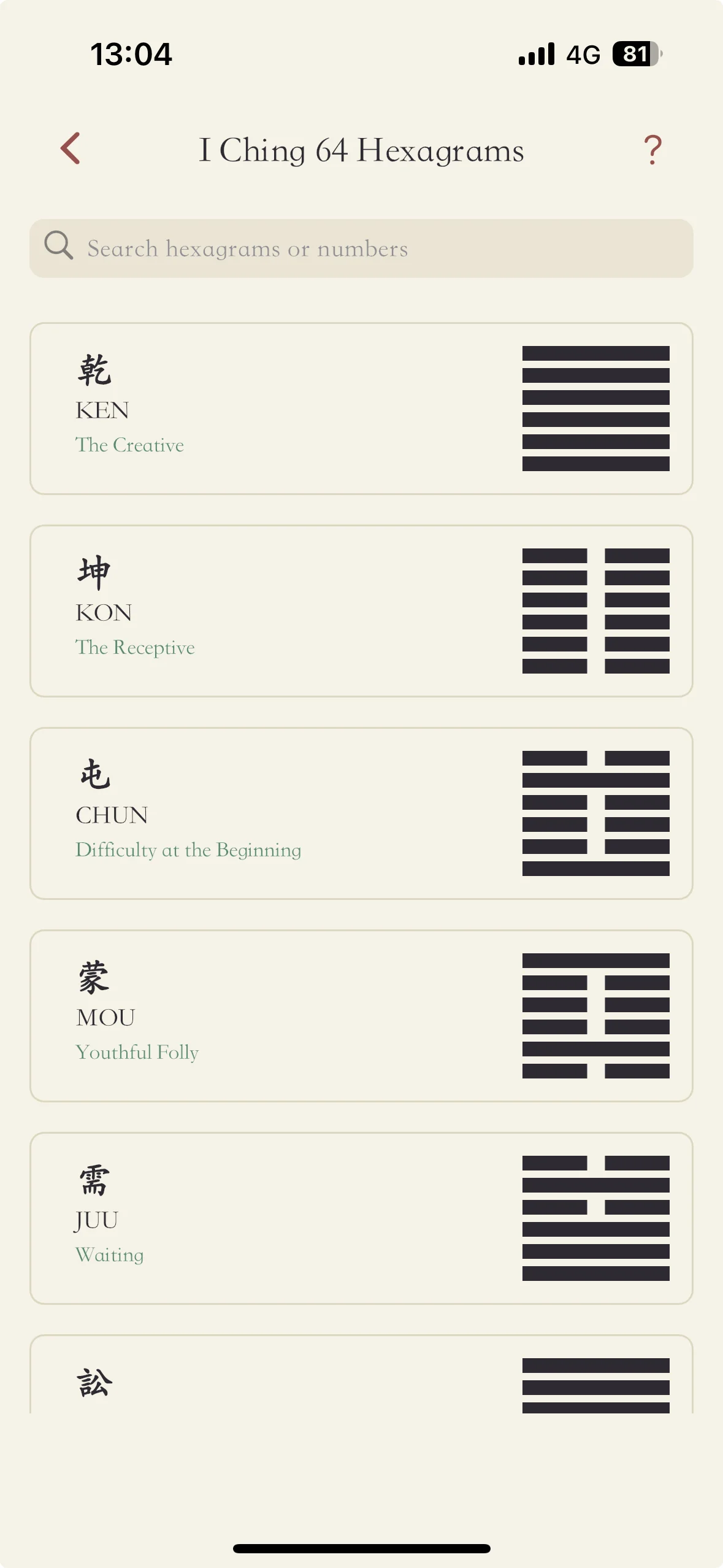
The I Ching consists of 64 hexagrams and 384 lines that systematize the laws of change in nature. Far more than a divination manual, it is a philosophical masterwork — Confucius reportedly wore out the binding of his copy three times from rereading it.
In the West, Leibniz drew inspiration for binary mathematics from the I Ching, Jung developed his theory of synchronicity partly from it, and Niels Bohr saw parallels with quantum complementarity. Its wisdom transcends cultures and centuries.
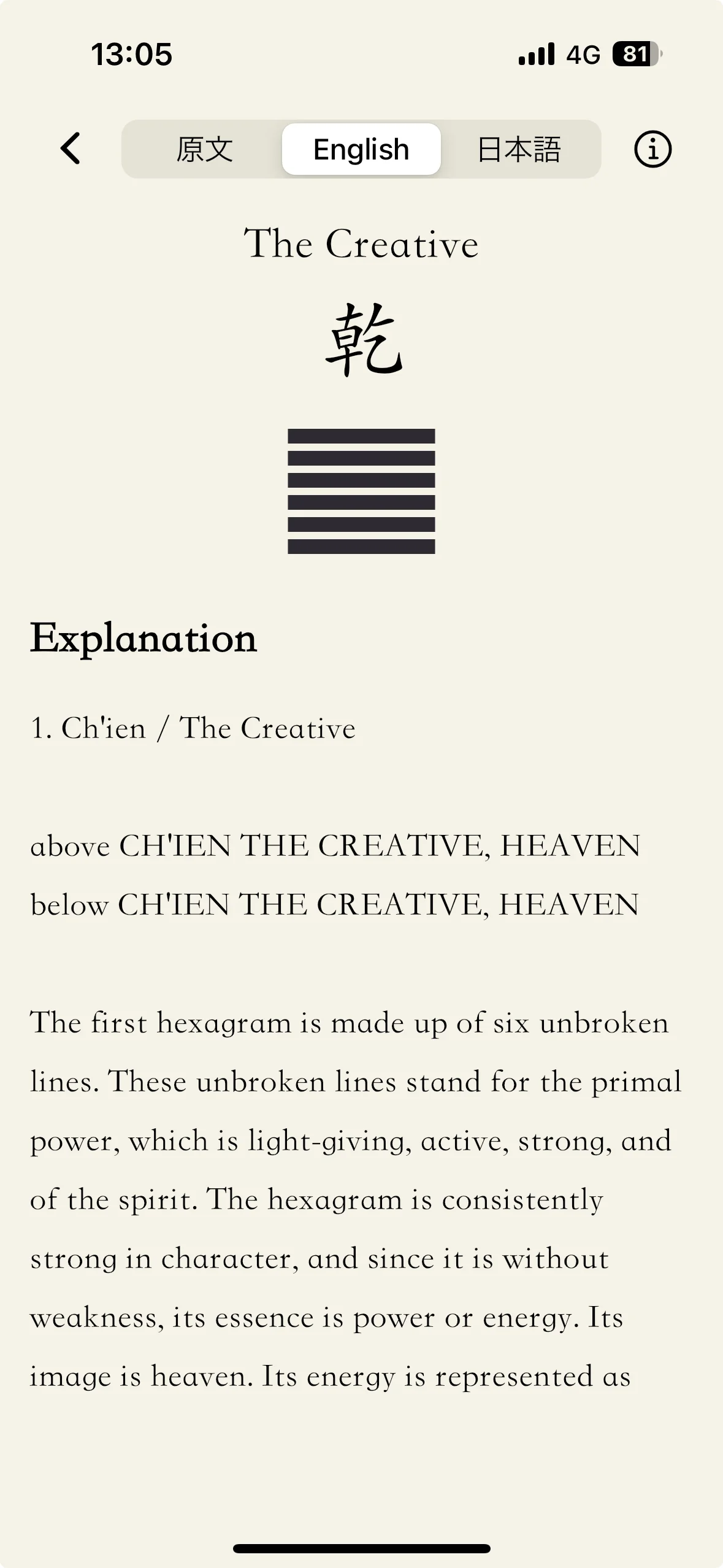
Combinations of yin (⚋) and yang (⚊) lines form 64 hexagrams, covering every situation in human life.
The character "Yi" means "change." The I Ching assumes constant flux and reveals how to act in each present moment.
Traditional I Ching divination uses 50 yarrow stalks in a complex process to derive hexagrams. I Ching AI faithfully reproduces this algorithm digitally.
I Ching AI merges the 3000-year-old classic "I Ching" (Book of Changes) with cutting-edge AI technology.
Our AI has learned from 200,000+ characters of I Ching texts to provide personalized interpretations tailored to your situation. Not just fortune telling—we give you concrete next steps.
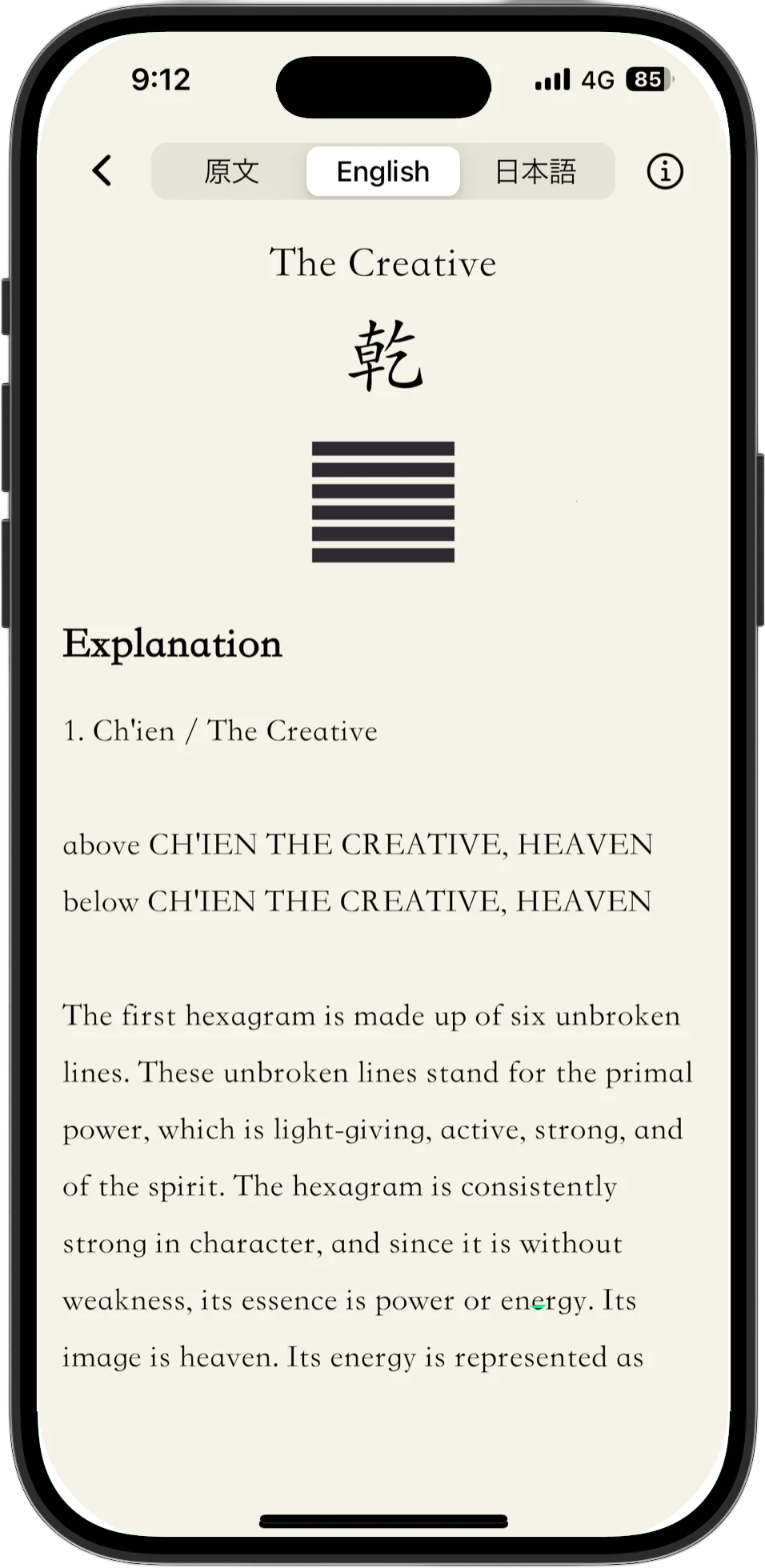
Based on traditional yarrow stalk divination algorithms, generating hexagrams with clear interpretations.
Get tailored advice with next steps, to-do lists, and even message templates. Your reading becomes immediate action.
Ask unlimited follow-up questions. "Tell me more" or "From another angle"—until you're fully satisfied.
Late-night anxiety or morning decisions—your AI advisor responds instantly whenever you need guidance.
Your conversations are never stored on our servers. Ask embarrassing questions freely—it's just you and AI.
Understand hexagram structures without complex classical Chinese. Enjoy the philosophy behind the wisdom.
Should I reply? Keep my distance? When to confess?
Job change timing / Performance reviews / Starting a business
Pre-negotiation mindset / Team coordination / Critical decisions
When anxiety clouds your mind and you can't talk to anyone
"I have an important business meeting this afternoon. What mindset should I bring?"
Today shows a transformation from "Lü" (Treading) to "Chieh" (Limitation). With the changing lines at the fourth and top positions, this clearly indicates how to navigate "this negotiation right now" and what kind of resolution to aim for.
The primary hexagram "Lü" represents "treading on the tiger's tail"—carefully stepping through dangerous territory with utmost caution. Heaven above, Lake below—a clear separation between "high" and "low," "superior" and "subordinate." Historically, this has been read as maintaining propriety while crossing dangerous ground within hierarchical relationships.
Applied to today's negotiation, this suggests a situation with power dynamics, positional differences, and subtle conflicts of interest. Your every word and action could determine whether you "step on the tiger's tail" or not.
However, the hexagram text states: "Treading on the tiger's tail, it does not bite; success." Though you tread on the tiger's tail, you won't be bitten and can pass through successfully. This is conditional success. The key is maintaining propriety and discretion, and conducting yourself with softness atop strength.
The fourth line states: "Treading on the tiger's tail with apprehension; ultimately auspicious." "Apprehension" means nervousness, caution, humility. In other words, being almost overly careful today is exactly right. Stay sensitive to the other party's expressions and words; if you sense you might be overstepping, step back and observe. This caution leads to "ultimate good fortune."
The top line states: "Look at the treading and examine the omens; the turning brings great good fortune." This position calls for surveying the whole while reflecting on each step. In negotiation terms, focus not on winning individual points, but on "how to conclude this entire negotiation" and "how to land this for the long-term relationship."
The resulting hexagram is "Chieh"—the hexagram of "moderation," "limitation," and "balance." Water above Lake, like a dam preventing overflow. Don't overdo it, don't give too much, tighten where tightening is needed. This moderation allows things to last without harming resources or relationships.
However, it also warns: "Bitter limitation cannot be maintained." Excessive strictness or over-tightening shouldn't continue—overdoing it leads to deadlock. Today's negotiation requires "pursuing terms with moderation without squeezing too hard" and "not forcing unreasonable compromises on yourself either."
Specifically, the following balance is key:
Early stage: Listen carefully to the other party's circumstances, true intentions, and constraints. Rather than presenting rigid conditions from the start, approach with "where can we both be comfortable?" This aligns with Lü's cautious apprehension.
Middle stage: Quietly determine your line—"I can concede this far" and "beyond this is impossible for me and my company." Then maintain that line while communicating softly, preserving the other party's dignity. This is how "peaceful limitation brings success" works.
Final stage: As you approach conclusion, strongly maintain the perspective of "not this single win or loss, but the overall relationship going forward." Reflect on your approach and ask, "Will this landing feel 'not bad' to them too?"
Be careful of the "bitter limitation" pitfall. For example, if you say "This is our limit" or "Absolutely no more than this" in a way that's logically correct but emotionally leaves no room, the other party may leave feeling "I understand, but couldn't something more be done?" Even if terms can't change, how you say it and how you leave room for future possibilities determines whether it becomes "bitter" or "peaceful" limitation.
For the final stage, while firmly maintaining your lines, include messages like: "This is our best for now, but we'd like to revisit if circumstances change" or "Within these terms, we want to be flexible in execution to maximize value for you." This is "now we're here, but we want to continue this relationship."
Overall, "Lü → Chieh" calls for careful steps and moderate closure precisely because the situation is delicate. By valuing both consideration for the other party's position and maintaining your own lines, ending with "a slightly unsatisfying closure" leaves seeds of "great good fortune" for future relations.
Using I Ching AI for divination is surprisingly simple. Follow these steps and you'll receive an authentic I Ching reading with detailed AI-powered advice.
Open the app and tap the divination button to start. No complicated setup — it's that simple.
Describe what's on your mind. Your registered profile (age, gender, occupation) is automatically considered, but the more detail you provide about your current situation and dilemma, the more specific and actionable the interpretation becomes.Tip: Specific questions get better answers than vague ones.
The app uses the same precise algorithm as traditional yarrow stalk divination to calculate your hexagram and changing lines. Tap the hexagram name to explore the original I Ching text — a great way to learn as you go.
Tap the chat icon at the bottom to enter dialogue mode with the AI I Ching master. After a moment, a detailed interpretation and concrete, actionable advice tailored to your situation will appear.
Have questions or want more clarity? Keep the conversation going. "Can you be more specific?", "What about from another perspective?", "What should I actually do?" — dialogue as many times as you need.
The quality of your I Ching reading depends significantly on how you frame your question. Specific, detailed questions yield far more actionable advice than vague ones.
"What's my career fortune?"
"Should I stay at my current company or start job hunting in March?"
"Love fortune"
"Should I reach out to my ex who I broke up with six months ago? I'm considering reconciliation."
"My future outlook"
"How should I prepare mentally for next month's business negotiation?"
Include "when," "who," and "what" you're struggling with. The more specific your context, the more precisely the AI can apply the I Ching's wisdom to your life.
Frame it as "Should I do A or B?" if you're torn between choices. The I Ching was originally designed to answer "advance or retreat?" questions.
Your current position, the history so far, how you feel right now. The more the AI I Ching master knows, the more its advice becomes a concrete, actionable plan.
"I can ask embarrassing questions freely since it's AI. Love being able to dig deeper until I'm satisfied."
"Asked about improving my relationship—got specific message templates. Was able to take action immediately."
"Clarified my priorities for job hunting. The interview prep tips and mindset advice were invaluable."
"Even at 3am when anxiety hits, I can consult immediately. Helps organize my feelings into concrete actions."
Yes. Your conversations are never stored on our servers. Feel safe discussing sensitive topics about relationships, career, and family.
AI generates complex interpretations, so it may take a few seconds to about 10 seconds. Consider it time invested for deeper insights.
Yes. After your reading, you can ask unlimited follow-up questions in the chat. "Tell me more" or "From another perspective"—keep going until satisfied.
Absolutely. Since it's AI, you can ask questions you'd never ask a person. This is one of I Ching AI's biggest advantages.
I Ching AI provides insights based on 3000 years of wisdom, but final decisions are yours. Use it as a reference for decision-making.
A free trial is available so you can try all features. Continued use requires a monthly subscription.
Be specific about your situation and choices. Instead of "What's my career fortune?", try "Should I stay at my current company or start job hunting in March?" The more context you provide, the more specific and actionable the AI's advice becomes.
Not at all. Simply tap the divination button and enter your concern. No knowledge of yarrow stalks is needed — the app uses an authentic algorithm to cast the hexagram, and the AI I Ching master explains everything clearly.
The I Ching is the world's oldest book of wisdom, originating in China about 3,000 years ago. Composed of 64 hexagrams and 384 lines, it systematizes the laws of change in nature. Confucius, Leibniz, Jung, and Niels Bohr were all influenced by it. I Ching AI fuses this ancient wisdom with modern AI technology.
Full features available with a monthly subscription.
Free trial available. Try it now.
*Subscription auto-renews monthly. Cancel anytime from App Store settings.
Download Free