Confucius and the I Ching: The Ten Wings That Made It Philosophy
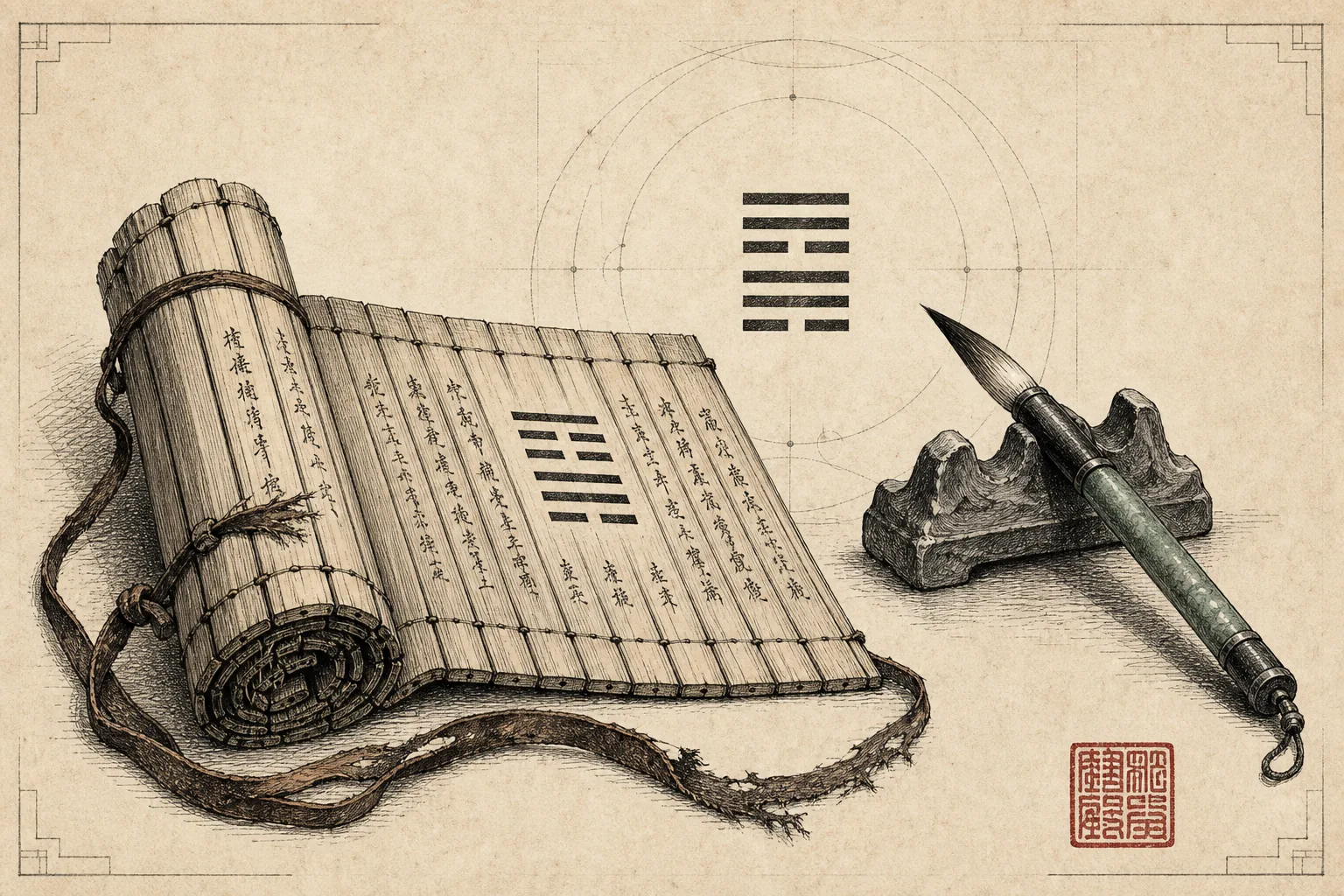
Before Confucius, the I Ching was a manual of divination — a book consulted by court diviners of the Zhou dynasty about whether to make war, marry, or sacrifice. After Confucius — or, more accurately, after the school that bore his name — it was the foundational philosophical canon of East Asia, studied by every educated person from Beijing to Kyoto for two thousand years. The transformation happened through ten short commentaries called the Ten Wings.
The legend of the broken thongs
The most famous image of Confucius and the I Ching comes from a single line in the Shiji, the great Han-dynasty history compiled by Sima Qian around 100 BCE. Discussing Confucius's late-life studies, Sima Qian writes that he became so absorbed in the Yi that the leather thongs binding his bamboo-strip copy broke three times from rereading. The phrase — wéi biān sān jué (韋編三絕) — became proverbial. To this day, a Chinese reader who calls a book wei bian san jue is saying that they have read it to pieces.
The image is concrete in a way most ancient anecdotes are not. Before the invention of paper-bound codices, a book in pre-imperial China was a series of bamboo slips drilled at one end and tied together with leather thongs. The slips remained loose until tied; the binding had to bear the weight of constant unrolling. To break three sets of thongs on the same book is to have unrolled it, reread it, rolled it back, and unrolled it again, many thousands of times.
Whether the legend is literally true is impossible to verify. What is certain is that by Sima Qian's day — four centuries after Confucius — the I Ching was so closely associated with him that his name and the book's name had become inseparable.
What Confucius actually said
The Analects — the collection of Confucius's recorded sayings compiled by his students — contains only one direct reference to the I Ching, in Book 7. It is brief and easily missed.
"The Master said: 'If some years were added to my life, I would give fifty to the study of the Yi, and might then escape falling into great errors.'"
— Analects 7.17 (Legge translation)
The passage is short, but its rhetorical weight is enormous. Confucius is in old age. He has spent his life teaching ren (benevolence) and li (ritual propriety). And he says, as a kind of confession, that he wishes he had begun studying the I Ching earlier — that the study of changes is the discipline most likely to keep him from grave moral mistakes.
This is not the casual endorsement of a magician's textbook. The implication is that the I Ching contains a knowledge of how situations transform — moral, social, political — that even a sage like Confucius felt he had not fully internalized.
The textual situation is complicated. A variant in some early manuscripts reads yi ("also") instead of Yi (易), which would change the passage to "I would also study, and might then escape falling into great errors." Han scholars argued about this for centuries. By the Tang dynasty, the consensus was firmly that Yi referred to the I Ching, and that reading has been authoritative ever since.
The Ten Wings
The ten commentaries traditionally attributed to Confucius are called the Shi Yi (十翼), literally "Ten Wings" — the wings that allow the I Ching, otherwise a body of cryptic divinatory remarks, to fly into philosophy. They are short, dense, and almost certainly not by Confucius personally. But they are unmistakably Confucian in spirit.
- 1–2. Tuan Zhuan (彖傳), Commentary on the Judgments
- Two parts; explains the meaning of each of the 64 main hexagram statements.
- 3–4. Xiang Zhuan (象傳), Commentary on the Images
- Two parts; gives the symbolic image of each hexagram and each line, and draws an ethical maxim from it.
- 5–6. Xici Zhuan (繫辭傳), the Great Treatise
- Two parts. The most philosophical of all the Wings: a sustained meditation on what the I Ching is, how it works, and what kind of cosmos it presupposes.
- 7. Wenyan (文言), Commentary on the Words
- Detailed commentary, present only for the first two hexagrams (Qian and Kun).
- 8. Shuogua (說卦), Discussion of the Trigrams
- Explains the symbolic associations of the eight trigrams (heaven, earth, mountain, lake, etc.).
- 9. Xugua (序卦), Sequence of the Hexagrams
- Brief commentary explaining the logical/narrative reason for the order of the 64 hexagrams.
- 10. Zagua (雜卦), Miscellaneous Notes on the Hexagrams
- Short pithy comments comparing pairs of hexagrams.
Without the Ten Wings, the I Ching would be a baffling object — a string of one-line judgments and six-line oracle responses, with almost no explanation. With them, it is a complete philosophical system, with a metaphysics, an ethics, and a cosmology.
The Great Treatise: a metaphysics of change
If only one of the Wings survived, the Xici Zhuan — the Great Treatise — would be enough to reconstruct most of what later became Confucian and Neo-Confucian metaphysics. It is the closest thing the Chinese tradition has to Aristotle's Metaphysics.
The Great Treatise lays down a series of foundational claims that nearly every later East Asian philosopher would either build on or argue against:
Change is the substance of reality. "One yin, one yang — this is called dao." The dao is not a thing; it is the alternating rhythm of yin and yang itself.
The cosmos is intelligible because it is patterned. "The Yi has the Great Ultimate (taiji), which produces the two modes; the two modes produce the four images; the four images produce the eight trigrams." The 64 hexagrams are a complete typology of these patterns.
The sage reads the patterns. The sages of antiquity, the Treatise says, observed the cosmos, found these patterns, and made the Yi as a means for ordinary people to participate in cosmic intelligence.
Divination is a form of inquiry, not magic. Crucially, the Great Treatise does not present the I Ching as a way to compel the cosmos to answer. It presents it as a way for the human mind to align itself with patterns that are already there. The hexagram you receive is not a message; it is a snapshot.
This formulation is what Jung, twenty-three centuries later, recognized as a description of synchronicity. It is the philosophical kernel of the entire I Ching tradition.
Who really wrote the Ten Wings?
Traditional Chinese scholarship, from the Han dynasty through the late Qing, attributed all ten Wings directly to Confucius. Modern scholarship is more cautious. The current consensus, based on linguistic analysis, internal references, and comparison with excavated Warring States and early Han manuscripts (especially the Mawangdui silk text of the Yi, recovered in 1973), is roughly this:
The Ten Wings are Confucian, but they are not by Confucius. They were composed by members of the Confucian school over a period of perhaps two and a half centuries, between the late Warring States and the early Western Han — roughly 350 BCE to 100 BCE. The Tuan and Xiang commentaries appear to be the oldest, the Great Treatise somewhat later, the Shuogua and Wenyan later still.
This refinement does not weaken the tradition; if anything, it strengthens it. The Ten Wings are not the product of a single genius but of a sustained intellectual project, conducted by a community of scholars who believed the I Ching contained insights worth dedicating generations to.
Two thousand years of consequence
The Confucian reading of the I Ching — the reading the Ten Wings established — is the reading East Asia inherited. When Zhu Xi (1130–1200) systematized Neo-Confucianism, he placed the I Ching at the head of the Five Classics. When Korean and Japanese Confucianism developed in the Joseon and Edo periods, they did so largely as commentary on the same text. When Wang Yangming (1472–1529) rebelled against Zhu Xi's reading, he did so by re-reading the same Wings.
And when Richard Wilhelm spent twenty-two years in Tsingtao translating the I Ching into German — the translation that Jung wrote the foreword to in 1949 — the text he was translating was not the Zhou dynasty oracle book by itself. It was that oracle book together with the Ten Wings, presented as a single integrated work, as the Confucian tradition had received it.
You cannot read the I Ching, in any language, without reading Confucius. Or, more precisely, without reading the school that took his late-life remark in the Analects — that he wished he had given fifty years to the study of changes — and decided to do so on his behalf.
Read the I Ching as Confucius did
I Ching AI includes the original Chinese text together with the canonical Ten Wings commentary, alongside Wilhelm's German translation, the English Wilhelm-Baynes rendering, and a complete Japanese translation. An AI trained on 200,000+ characters of commentary helps you read each hexagram with its full Confucian and Neo-Confucian inheritance.
Download I Ching AI