Carl Jung and the I Ching: Synchronicity, Wilhelm, and the Foreword
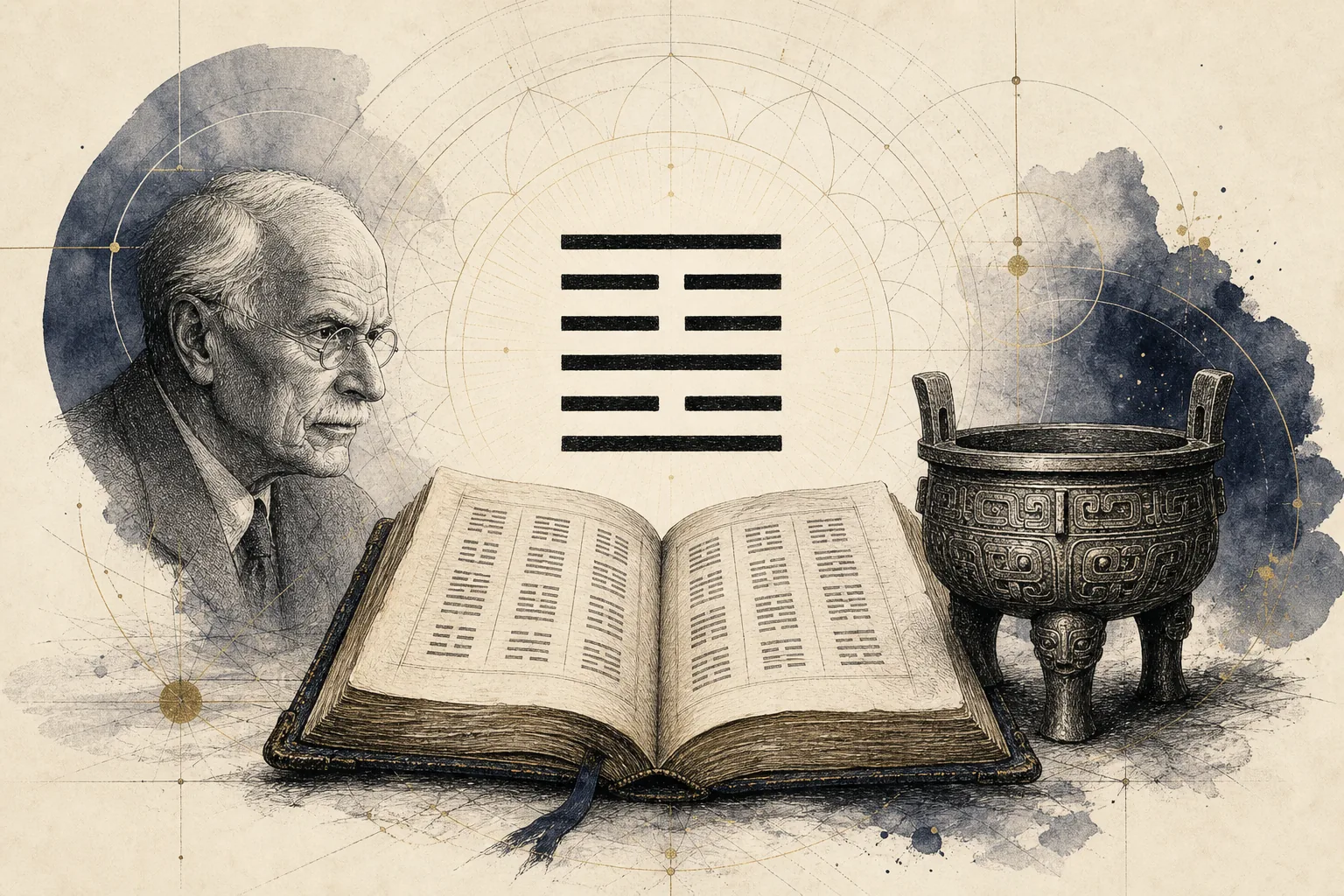
In 1949, after thirty years of personal consultation, Carl Jung sat down to write a foreword to Richard Wilhelm's English translation of the I Ching. Before beginning, he asked the book what it thought of being introduced to Western readers. The answer he received — and his response to it — would change how the West reads the Book of Changes.
Meeting Richard Wilhelm
Jung's encounter with the I Ching begins not in China but in Germany, with a Lutheran missionary who had spent twenty-two years in Tsingtao. Richard Wilhelm (1873–1930) had gone east as a clergyman, fell under the spell of classical Chinese philosophy, and eventually translated the Book of Changes into German under the patient guidance of the Confucian scholar Lao Nai-hsuan. The result, published in 1923, is still considered one of the great feats of cross-cultural translation in modern history.
Jung met Wilhelm in the early 1920s at Count Hermann Keyserling's School of Wisdom in Darmstadt, and the two became close friends. For Jung — already convinced that the European unconscious bore deep structural similarities to Eastern symbolic systems — Wilhelm was a revelation. Here was a Westerner who had not merely studied China but had been changed by it. Jung wrote later that Wilhelm "inoculated us with the living germ of the Chinese spirit."
Through Wilhelm, Jung gained access to a tradition he had previously only glimpsed in Sinological footnotes. He began consulting the I Ching personally, asking it questions about his own life, his patients, and his writing. He did so, by his own account, for "more than thirty years."
The 1949 foreword and Hexagram 50
When Cary F. Baynes prepared the English edition of Wilhelm's translation for the Bollingen Foundation, Jung agreed to write the foreword. He approached the task with characteristic candor. Rather than describe the I Ching from a safe scholarly distance, he proposed an experiment: he would ask the book itself what it thought of being translated for an American audience that had no living tradition for it.
Using the three-coin method, he obtained Hexagram 50, Ting / The Cauldron (鼎), with changing lines in the second and third places, transforming into Hexagram 35, Chin / Progress.
"I made this experiment with the I Ching in 1949. I asked the book what it thought of my intention to present it to the Western mind. The answer was Hexagram 50, The Cauldron — the vessel that contains, transforms, and nourishes spiritual food."
— Jung, foreword to the Wilhelm/Baynes I Ching, 1950
Jung read the response as both apt and humorous. The cauldron is the ritual vessel of ancient Chinese cult, the instrument that "transforms physical nourishment into spiritual nourishment." That the I Ching would describe its own translation in this image struck him as more than coincidence — and more than projection. It struck him as meaningful.
What made the answer particularly arresting was the changing lines. The nine in the second place warned: "There is food in the ting / My comrades are envious / But they cannot harm me." The nine in the third place said: "The handle of the ting is altered / One is impeded in his way of life." Jung read in both lines the predicament of a difficult, divisive book — one that would be valued by those willing to enter it on its own terms, dismissed by those who could not.
Synchronicity: the acausal principle
The foreword episode was not an isolated curiosity. Jung had been wrestling for years with a class of phenomena that classical causality could not explain — dreams that anticipated waking events, coincidences too pointed to be random, oracles that seemed to address the person consulting them. By 1952, in collaboration with the physicist Wolfgang Pauli, he had given these phenomena a name: synchronicity, an acausal connecting principle.
The I Ching was, for Jung, the cleanest available demonstration of how synchronicity works. The hexagrams are not caused by your question; the coins or yarrow stalks fall by ordinary physical processes. And yet, when the question is asked seriously, the resulting hexagram tends to be — strangely, repeatedly — relevant. Jung's hypothesis was that the moment of casting is a unique configuration of psyche and world, and that the hexagram reads that configuration the way a thermometer reads a temperature.
"The Chinese mind," he wrote, "as I see it at work in the I Ching, seems to be exclusively preoccupied with the chance aspect of events. What we call coincidence seems to be the chief concern of this peculiar mind, and what we worship as causality passes almost unnoticed."
It is important to note what Jung was not claiming. He did not assert that the I Ching tells the future, nor that the hexagrams are messages from a deity. His position was more careful: a serious consultation creates a moment in which inner and outer constellations are visible together, and the symbolic richness of the hexagram allows that moment to be read.
Why Jung trusted the method
Jung's defense of the I Ching rested on three observations, all of which are consistent with his broader psychology.
First, the projective surface is rich. A hexagram contains six lines, a primary trigram structure, often changing lines that produce a second hexagram, and centuries of commentary attached to each element. The interpretive material is vast enough that a serious consultant cannot simply read what they wanted to hear; the text resists premature closure.
Second, the question matters. Jung repeatedly emphasized that the value of an oracle is proportional to the seriousness of the question. A frivolous question gets a frivolous response — not because the oracle is offended, but because the inner state of the questioner is not coherent enough to produce a readable configuration.
Third, the answer is a beginning, not an end. The hexagram does not close the question; it reframes it. The work of integration — what the answer means for this situation, this person, now — remains with the consultant. This was, for Jung, the same work that analysis itself performed.
In a letter to a correspondent in 1956, he was characteristically direct: "I use the I Ching as a rule when I feel my counsel is unwise and that I do not know better. It is not used as a parlor game or for fortune-telling purposes, but as a means of clarification of psychological situations."
Jung's legacy and the I Ching today
Jung's foreword did more than introduce the Bollingen edition. It legitimized, for a generation of Western readers, the idea that one could engage seriously with the I Ching without surrendering one's intellect. Hermann Hesse, John Cage, Philip K. Dick, Bob Dylan, and many others read the book in part because Jung had read it first.
The Wilhelm/Baynes I Ching with Jung's foreword is still in print today, more than seventy years after first publication. It remains the canonical English entry point — flawed in some places by Wilhelm's nineteenth-century theological frame, brilliant in many others — and the foreword is still the most lucid short account of what the I Ching is and is not.
What Jung never had access to, however, was a way to make the consultation portable and conversational. In his time, an interpretation required either fluency in Wilhelm or a teacher; for most readers, the bridge between text and life was difficult to walk alone.
Frequently asked questions
What did Carl Jung say about the I Ching?
Jung treated the I Ching as a serious psychological instrument rather than fortune-telling. He consulted it personally for more than thirty years and wrote in 1956: "I use the I Ching as a rule when I feel my counsel is unwise and that I do not know better. It is not used as a parlor game or for fortune-telling purposes, but as a means of clarification of psychological situations."
What hexagram did Jung receive when he asked the I Ching about his foreword?
In 1949, before writing his foreword to the Wilhelm-Baynes translation, Jung asked the book what it thought of being presented to the West. Using the three-coin method he obtained Hexagram 50, Ting / The Cauldron (鼎), with changing lines in the second and third places, transforming into Hexagram 35, Chin / Progress. He read the cauldron — a vessel that transforms nourishment into spiritual food — as an apt and meaningful reply.
How does the I Ching relate to Jung's theory of synchronicity?
Jung used the I Ching as his clearest example of synchronicity — an "acausal connecting principle" he named in 1952 with the physicist Wolfgang Pauli. The hexagram is not caused by your question (the coins fall by ordinary physics), yet a serious consultation tends to produce a relevant answer. Jung's hypothesis was that the moment of casting is a unique configuration of psyche and world that the hexagram reads the way a thermometer reads temperature.
Did Jung believe the I Ching predicts the future?
No. Jung explicitly did not claim the I Ching tells the future, nor that hexagrams are messages from a deity. His position was that a serious consultation makes inner and outer conditions visible together, and that the symbolic richness of the hexagram lets that moment be read and reframed — "a beginning, not an end."
Who introduced Jung to the I Ching?
Richard Wilhelm (1873–1930), the German missionary-sinologist whose 1923 German translation of the I Ching became famous. Jung met Wilhelm in the early 1920s at Hermann Keyserling's School of Wisdom in Darmstadt, and later said Wilhelm "inoculated us with the living germ of the Chinese spirit."
Try the I Ching in the spirit Jung intended
I Ching AI includes the original Chinese text alongside three full translations: Wilhelm's celebrated German rendering, the English Wilhelm-Baynes edition Jung wrote the foreword to, and a complete Japanese translation. An AI trained on 200,000+ characters of commentary helps you read the answer in the way Jung described — as a beginning, not an end.
Download I Ching AI