Niels Bohr and the I Ching: Yin-Yang on a Quantum Physicist's Coat of Arms
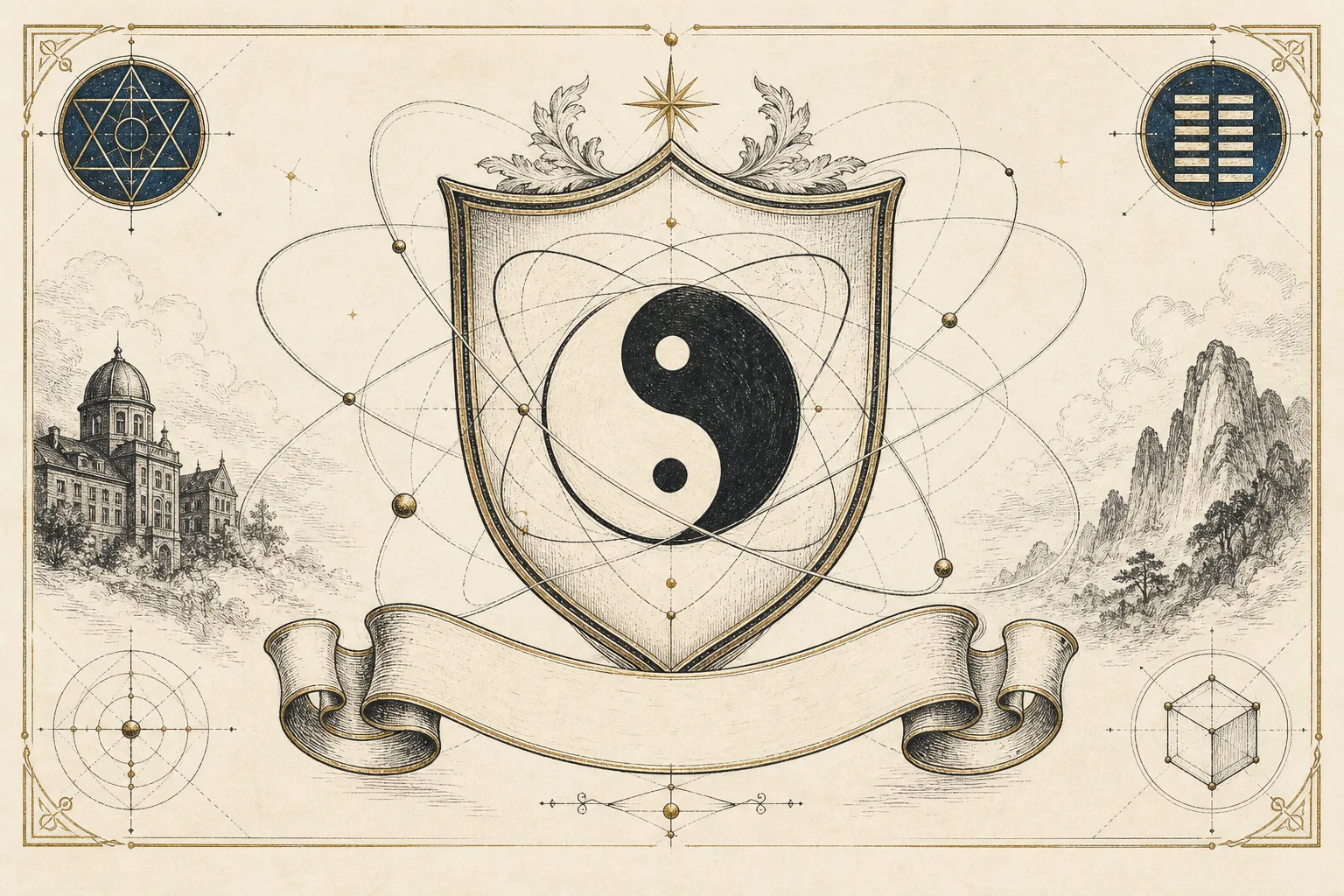
In October 1947 King Frederik IX of Denmark conferred upon Niels Bohr the Order of the Elephant, the highest civilian decoration in the country. The order required Bohr to design a coat of arms to be hung at Frederiksborg Castle. He chose, for the central charge of his shield, the taijitu — the swirling black-and-white emblem of yin and yang that has stood at the head of the I Ching tradition for two thousand years. The motto below it reads: Contraria sunt complementa. Opposites are complementary.
Complementarity in physics
By 1927, when Bohr first articulated the principle of complementarity at the Como conference in northern Italy, quantum mechanics had produced a result that classical physics could not absorb. An electron was, depending on how you measured it, a particle or a wave. The two descriptions could not be reconciled into a single picture; either was needed at different moments, and both were complete on their own terms.
Bohr's response was to refuse the demand for a single picture. The wave description and the particle description, he argued, are complementary: each is necessary for a full account of the phenomenon, but they cannot be applied simultaneously. The choice of experimental setup determines which face nature shows. This was the philosophical core of what came to be called the Copenhagen interpretation.
It was a position with no precedent in Western metaphysics, which from Aristotle onward had treated mutually exclusive predicates as a sign that at least one of them must be false. To say that a single thing both is and is not a particle, depending on the question asked of it, sounded — to many of Bohr's contemporaries — like an evasion.
Bohr's 1937 visit to China
A decade after Como, Bohr undertook a lecture tour through East Asia. From spring through summer of 1937 he travelled to Beijing, Nanjing, Shanghai, Hangzhou, Hong Kong, and Tokyo, accompanied by his wife Margrethe. The Chinese leg was extensive enough that he met with university scholars in multiple cities and was exposed at length to the Confucian and Taoist intellectual traditions still alive at the time.
According to later recollections by his son Hans Bohr and by his close collaborator Léon Rosenfeld, it was during this trip that Bohr first encountered the taijitu and recognized in it a symbol of what he had been arguing in physics for ten years. Two principles, drawn as a single shape, neither subordinate to the other, each containing a seed of the other — a graphic of complementarity older than European philosophy.
Bohr did not claim that Taoism had taught him quantum mechanics. He did not need it to: complementarity emerged from his struggle with experimental data, with Heisenberg's matrix mechanics, with Schrödinger's wave equation. What the taijitu offered him was something different — a language, an inherited visual grammar, for a relation that European thought had no ready picture for.
The coat of arms
When the herald's office in Copenhagen asked Bohr for his arms, he proposed a design that almost certainly nobody in twelfth-century Europe would have recognized as heraldry. The shield is divided per pale silver and gold, charged with a taijitu in sable and argent — the classical yin-yang circle. Above the shield is the helmet appropriate to a Knight of the Elephant; below is the scrolled motto.
"Contraria sunt complementa."
— Motto of Niels Bohr's coat of arms, 1947
The Latin is Bohr's own, not a quotation. He chose it carefully. The verb sunt — "are" — does the entire philosophical work. He did not write fiunt ("become") or videntur ("seem"). The opposites simply are complementary, in the same way and to the same degree that the electron simply is both wave and particle.
The arms still hang at Frederiksborg Castle north of Copenhagen, in the Chapel of the Order of the Elephant. Visitors who do not know whose shield it is sometimes assume it commemorates a diplomat to East Asia.
Was Bohr influenced by Taoism?
The honest answer is: not in the way that Leibniz was influenced by the hexagrams. Leibniz looked at the Fu Xi diagram and saw a binary number system; the Chinese tradition was, for him, evidence that his independent invention was correct. Bohr's situation was the opposite. He had already arrived at complementarity from physics. The taijitu was, for him, a confirmation rather than a source — proof that his strange new idea had a venerable analogue in another tradition.
This distinction matters. There is a long popular tradition, starting roughly with Fritjof Capra's The Tao of Physics (1975), that wants to read modern physics as a recovery of Eastern wisdom. Bohr himself was more careful. He did not believe quantum mechanics had been discovered by Lao Tzu; he believed that the human mind, faced with certain kinds of structural problems, repeatedly produces complementary descriptions, and that some traditions have noticed this earlier than others.
His grandson, Tomas Bohr (himself a physicist), has said in interviews that the family understood the coat of arms in this spirit: not as mysticism, but as a recognition that the same logical structure can appear in radically different cultural settings.
What the symbol means now
The taijitu on Bohr's shield is part of a longer story. The I Ching is the textual elaboration of exactly the principle Bohr's motto names: every hexagram is a six-line configuration of yin and yang, and every situation the book describes is read as a balance between complementary forces in motion. The 64 hexagrams are, in a sense, a typology of complementarity.
What Bohr put on his shield is the seed; the I Ching is the tree. To consult one of the 64 hexagrams about a real-world situation is to do, at the level of everyday life, what Bohr did at the level of subatomic physics: refuse the demand for a single picture, ask which complementary description the moment requires, and decide on that basis.
Frequently asked questions
Why did Niels Bohr put the yin-yang symbol on his coat of arms?
When Bohr was made a Knight of the Elephant in 1947, he designed arms bearing the taijitu (yin-yang) with the motto Contraria sunt complementa ("opposites are complementary"). He chose the symbol because it visually captured his physics principle of complementarity — two mutually exclusive descriptions, neither subordinate to the other, each containing a seed of the other.
What does "Contraria sunt complementa" mean?
It is Latin for "opposites are complementary." The motto is Bohr's own composition, not a quotation. He chose the verb sunt ("are") deliberately — not fiunt ("become") or videntur ("seem") — to say that opposites simply are complementary, in the same way an electron simply is both wave and particle.
Was Bohr's complementarity principle influenced by Taoism or the I Ching?
Not as a source. Bohr arrived at complementarity from physics — his struggle with quantum data, Heisenberg's matrix mechanics, and Schrödinger's wave equation — and first stated it at the 1927 Como conference. He encountered the taijitu during his 1937 visit to China and took it as a confirmation of an idea he already held, not its origin. He never claimed Taoism had taught him quantum mechanics.
When did Bohr visit China?
From spring through summer of 1937 Bohr toured East Asia with his wife Margrethe, visiting Beijing, Nanjing, Shanghai, Hangzhou, Hong Kong, and Tokyo. According to his son Hans Bohr and his collaborator Léon Rosenfeld, it was on this trip that he first saw the taijitu and recognized in it the complementarity he had argued in physics since 1927.
How is the I Ching connected to Bohr's complementarity?
The I Ching is the textual elaboration of the principle Bohr's motto names: every hexagram is a six-line configuration of yin and yang, and every situation is read as a balance of complementary forces. In this sense the 64 hexagrams form a typology of complementarity — what Bohr placed on his shield as a seed, the I Ching develops at length.
Read the full text Bohr's shield refers to
I Ching AI presents all 64 hexagrams in the original Chinese, with Richard Wilhelm's German translation, the English Wilhelm-Baynes edition, and a complete Japanese translation. An AI trained on 200,000+ characters of commentary helps you find the complementary reading that fits your situation.
Download I Ching AI