How to Read the I Ching with Three Coins
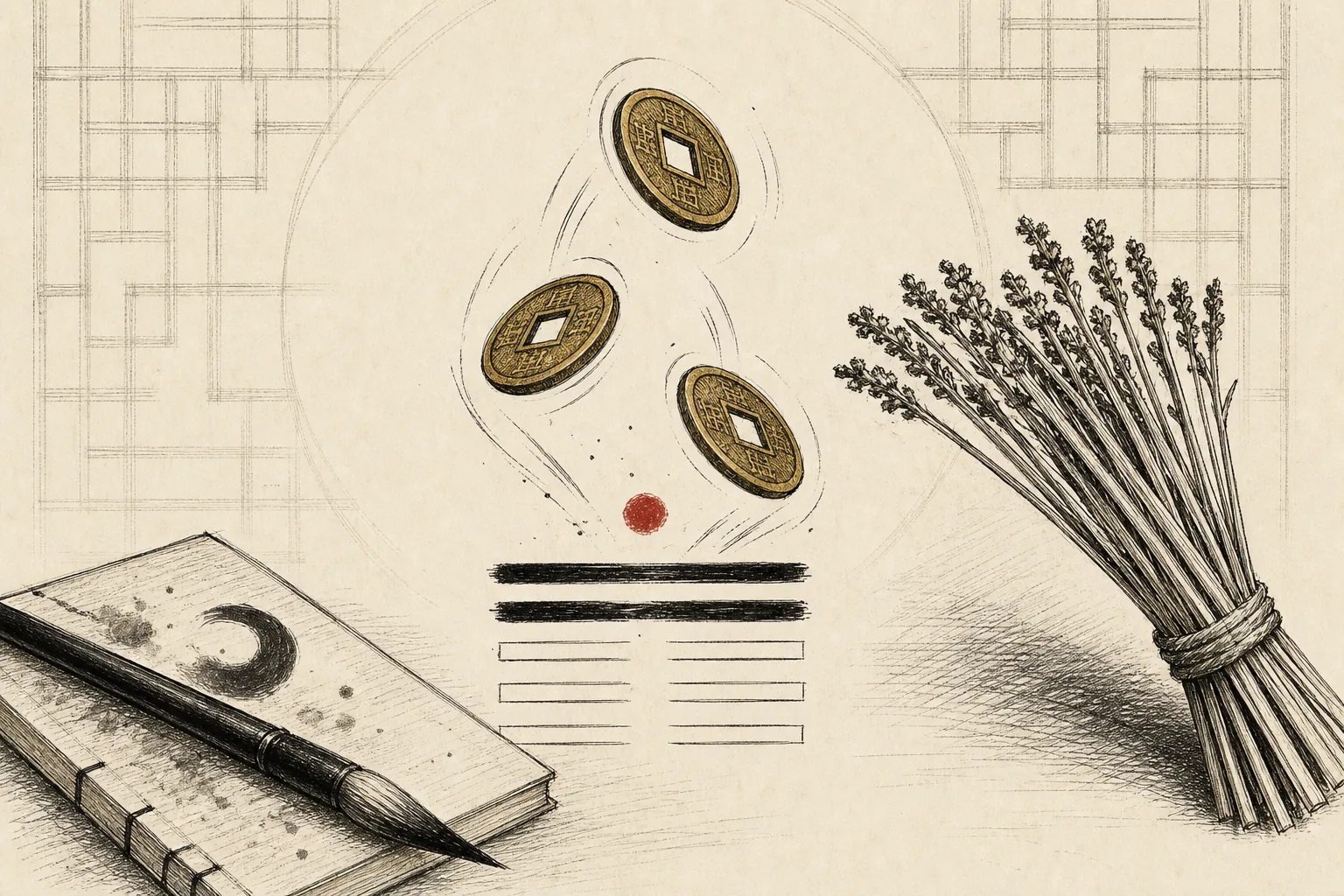
Start with three coins, paper and a question. Toss the coins six times and record each line from bottom to top. A total of 6 or 9 marks a changing line. This guide explains the coin values, how to identify your hexagram, and how to read its changing lines and relating hexagram.
Frame the question
The quality of a reading is bounded by the quality of the question. Vague questions get vague answers, not because the oracle is annoyed, but because the inner state of the questioner is not coherent enough to produce a readable result. A few principles that mature readers converge on:
- Ask about now, not the abstract future. "What is the right attitude toward this conversation tomorrow?" beats "Will I be happy in three years?"
- Avoid yes/no. The I Ching does not answer in yes/no terms. Ask "what is the shape of this situation?" or "what attitude should I bring to X?"
- Be specific. Name the person, the project, the choice. The book is not a fortune cookie; it responds to real situations.
- Take it seriously. If you would not write the question down, the question is not yet ripe.
Choose a method: coins, yarrow, or app
The traditional methods are the yarrow-stalk procedure (older, slower, more variable in line probabilities) and the three-coin method (faster, with slightly different line probabilities). Both are valid. The Wilhelm/Baynes edition describes both. For most people, the three coins are practical; for ritual occasions, some readers prefer the yarrow.
A digital app — for example, I Ching AI — implements the yarrow algorithm with a verified pseudo-random number generator. As John Cage and his collaborator Andrew Culver concluded already in 1984, what matters is the procedure and the seriousness of the question, not the physical implementation.
The three-coin method, step by step
You need three identical coins. The traditional Chinese coins with a square hole work, but any three coins do. Decide in advance which side is "yang" (3 points) and which is "yin" (2 points). The conventional choice is: heads (or the front of a Chinese coin with characters) = yang = 3.
Step 1
Toss the three coins. Add the values.
You will get one of four possible sums:
| Sum | Meaning | Line | Type |
|---|---|---|---|
| 6 | three tails (2+2+2) | broken with X | changing yin → yang |
| 7 | two tails, one head (2+2+3) | unbroken | stable yang |
| 8 | two heads, one tail (3+3+2) | broken | stable yin |
| 9 | three heads (3+3+3) | unbroken with O | changing yang → yin |
Step 2
Repeat five more times. Record the line each time, from bottom to top.
This is critical: the first toss is the bottom line of the hexagram. The last toss is the top line. The hexagram is built from the ground up.
Step 3
You now have a six-line hexagram, possibly with one or more changing lines.
Note carefully which positions (1st, 2nd, 3rd, 4th, 5th, 6th from the bottom) contain a 6 or a 9 — those are the changing lines.
The yarrow-stalk method, in brief
The classical method uses 50 yarrow stalks (one is set aside; 49 are used). The remaining 49 stalks are divided, counted, and re-divided in a specific procedure that takes around 15–20 minutes per line, ~90 minutes per hexagram. The Wilhelm/Baynes edition explains it line by line.
The yarrow method produces slightly different probabilities than the three-coin method (the original 7:8 ratio in yarrow gives more stable lines and fewer changing lines than the equal-probability coins). For most readers this difference is theoretical, but serious students often prefer the yarrow specifically because it forces the slower pace.
Identify your hexagram
Once you have the six lines (treating changing lines as their original state — 6 as broken, 9 as unbroken — for purposes of identifying the hexagram), look up the hexagram in the standard chart, which is included in every edition.
The chart works by the lower three lines (the lower trigram) and the upper three lines (the upper trigram). Find your lower trigram in the left column, your upper trigram in the top row, and the cell at the intersection gives the hexagram number, 1 through 64. The I Ching AI hexagrams page has a complete reference if you want to skip the lookup chart.
Read the judgment and image
Every hexagram has a brief judgment (a one or two sentence statement of the hexagram's basic situation) and an image (a poetic statement of how the situation appears in nature, with a maxim for the wise person). These are short and concentrated — read them slowly, twice, before reading any commentary.
For example, Hexagram 1 (the Creative) has the judgment: "The Creative works sublime success, furthering through perseverance." The image is: "The movement of heaven is full of power. Thus the superior man makes himself strong and untiring."
The Wilhelm/Baynes edition supplements these with longer commentaries based on the Ten Wings (the Confucian tradition). Read those second, after you have absorbed the judgment and image directly.
Read the changing lines
If you have any changing lines, read the corresponding line text in the hexagram. Each hexagram has six line texts, numbered from bottom to top.
The line text is more specific than the judgment — it describes the situation at a particular stage of the hexagram's process. If you had a 6 in the second position, you read the second line of the hexagram. If you had a 9 in the fifth position, you read the fifth line.
If you have multiple changing lines, read each in order from bottom to top. Some traditions hold that only the top changing line is decisive when there are many; others read all of them. The Wilhelm/Baynes approach reads all changing lines and lets the reader integrate.
Read the resulting hexagram
Once you have noted the changing lines in the primary hexagram, "flip" them — changing yin (6) becomes unbroken yang, changing yang (9) becomes broken yin — to produce a second hexagram. This is the resulting or derived hexagram, and it represents where the situation is going.
Read the judgment of the resulting hexagram. (You do not read its line texts; those would apply only if you had cast that hexagram with its own changing lines.) The pair — primary hexagram, resulting hexagram — together describes both the present situation and the direction it is unfolding in.
Habits of serious readers
The mechanics above are the entire procedure. What separates a casual reading from a deep one is not the mechanics but the habits around them:
- Write the question down before casting. The act of writing forces clarity. After the cast, write the hexagram below the question.
- Keep a reading journal. Date, question, hexagrams, line texts, your reflection. Patterns become visible across weeks.
- Do not consult repeatedly on the same question. If you ask twice within hours, you are not receiving guidance; you are arguing with the oracle. Let a day pass.
- Sit with the reading. The first interpretation that comes to mind is often shallow. Re-read the judgment two or three times over the course of the day.
- Read the commentary, but not first. Get your own first impression. Then read Wilhelm's commentary. Often they agree; when they disagree, the disagreement is itself useful information.
Carl Jung's foreword to the Wilhelm/Baynes edition makes the point that the I Ching's value emerges only with serious use — never on a first attempt. The same is true of any deep practice. Five readings will give you a feel for the mechanics; fifty will start to give you a relationship with the book.
Cast a reading right now
I Ching AI implements the traditional algorithm and presents your hexagram with the original Chinese, Wilhelm's German translation, the English Wilhelm-Baynes edition, and a complete Japanese rendering. An AI trained on 200,000+ characters of commentary helps you read the result in light of your specific situation.
Download I Ching AI