Joseph Needham and the I Ching: Science, Civilisation, and Correlative Thinking
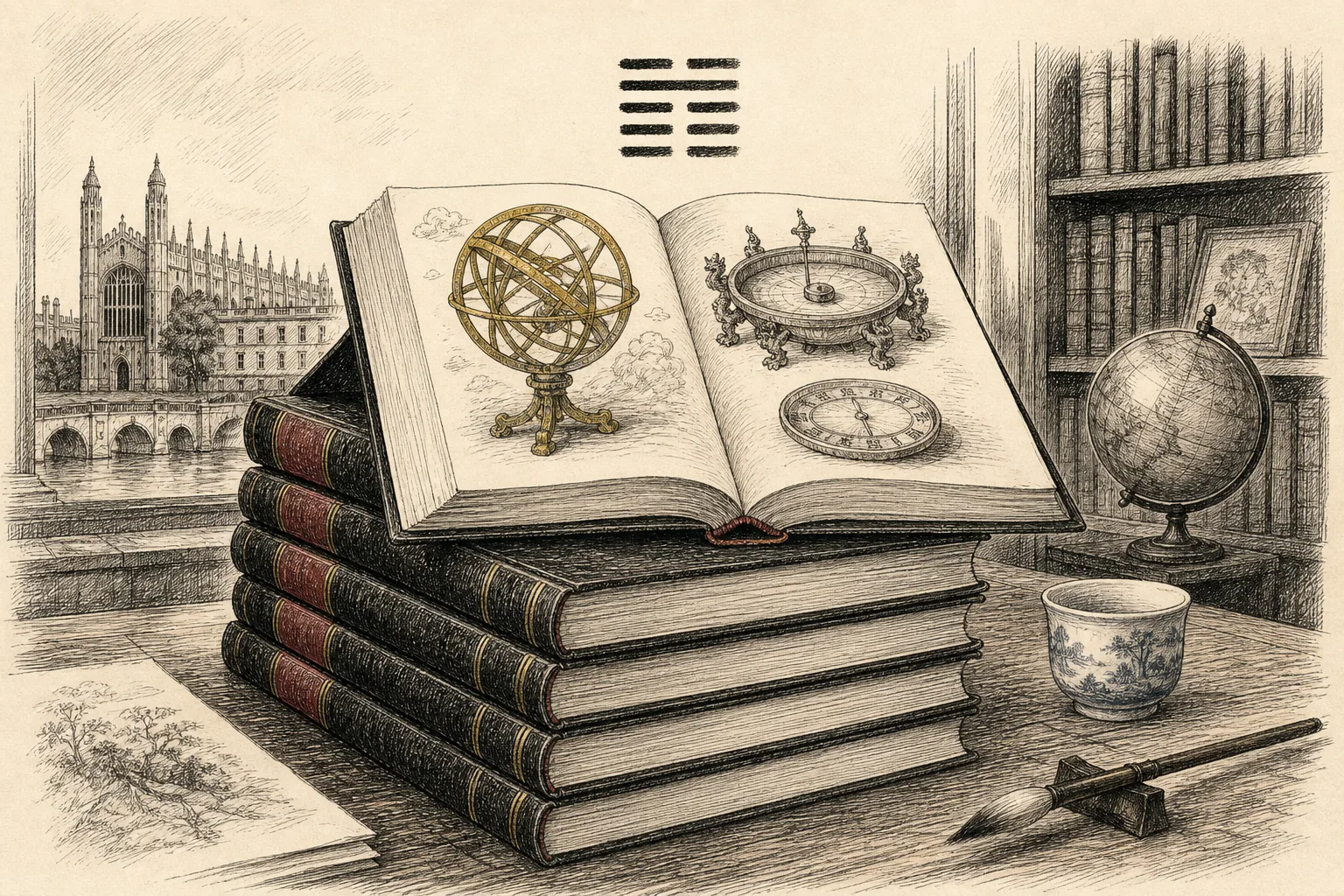
Joseph Needham (1900–1995) trained as a biochemist at Cambridge, met three Chinese graduate students in 1937, fell in love with one of them, taught himself classical Chinese in the evenings, and spent the next fifty-eight years writing Science and Civilisation in China — a 27-volume work that fundamentally altered how the West reads Chinese intellectual history. The I Ching appears throughout, but never as an oracle. For Needham, it was a serious theoretical document, and the question of why it had not led to modern science became one of the most important questions in twentieth-century history of science.
A biochemist becomes a sinologist
Needham was, by training, one of the leading biochemists of his generation. His three-volume Chemical Embryology (1931) is still cited. He was elected to the Royal Society at the age of forty-one for work that had nothing to do with China. The pivot came in 1937, when three Chinese postdoctoral researchers arrived in his Cambridge laboratory. One of them, Lu Gwei-djen, would become his lifelong collaborator and, after his first wife's death, his second wife. Through her, Needham began learning classical Chinese.
By 1942 he was in Chongqing as the head of the British Scientific Mission, traveling through Nationalist-controlled wartime China with a small team and accumulating notes, photographs, and books that would feed the project for the rest of his life. He returned to Cambridge in 1948, took up the directorship of the newly founded UNESCO Natural Sciences Department for two years, then settled into Caius College and began writing.
The premise was straightforward in concept and stunning in scale: write a complete history of Chinese science and technology, in English, covering every domain, with full attention to original sources and to the intellectual framework that produced them.
Science and Civilisation in China
Science and Civilisation in China began publication with Cambridge University Press in 1954. By the time of Needham's death in 1995, fifteen volumes had appeared. By 2025, the project had grown — with collaborators carrying it forward — to twenty-seven volumes covering mathematics, astronomy, geography, physics, chemistry, biology, agriculture, medicine, military technology, ceramics, textiles, and more.
The I Ching appears in many of these volumes, but its principal home is Volume 2: History of Scientific Thought, published in 1956. Volume 2 is Needham's account of the intellectual frameworks that shaped Chinese inquiry into nature — Confucianism, Daoism, Mohism, Legalism, the school of names, the Yin-Yang school, the Five Phases theory. The I Ching is treated as a foundational document of the last two, and the bulk of the book's central argument turns on what Needham calls correlative thinking.
The I Ching and correlative thinking
Correlative thinking, in Needham's usage, is the cognitive style that organizes the world into categories that mirror and resonate with one another rather than into chains of mechanical cause and effect. Spring corresponds to the east, to the color green, to wood, to the rising of yang energy, to the morning, to the liver in the body, to the dragon constellation. These correspondences are not metaphors; they are taken to express real relationships of resonance between domains. The same correlative scheme of directions, time, and the five phases underlies other classical Chinese arts of date and direction selection, such as the Qimen Dunjia chart calculator.
The I Ching, Needham argues, is the most fully developed expression of this cognitive style in the Chinese tradition. The 64 hexagrams are a typology of patterns; any situation can be read by locating it within this typology and observing how its components resonate with the components of other situations described by the same or related hexagrams. The system is not predictive in the way Western physics is predictive, but it is also not random: it generates internally consistent, testable inferences within its own framework.
"The I Ching, far from being a mere fortune-telling book, was an attempt to systematize the universe and to provide a key to the understanding of nature... Its categories were the categories of a fully realized correlative thought."
— Needham, Science and Civilisation in China, Volume 2, paraphrased
This was an important move. Before Needham, the dominant Western view treated the I Ching as either a superstition that had retarded Chinese science or, more sympathetically, as a fine poetic document with no scientific content. Needham's contribution was to take seriously its claim to systematicity — to argue that the book represents a sophisticated, if non-experimental, attempt to map the cosmos.
The Needham Question
The most famous formulation in Needham's body of work is the question that bears his name: "Why did modern science not develop in China?" Chinese civilization had, until roughly the sixteenth century, been ahead of Europe in almost every measurable technological domain — gunpowder, the magnetic compass, movable type, paper, the seismograph, the cast-iron blast furnace, the wheelbarrow. And yet the scientific revolution happened in Europe, not in China.
The I Ching sits in the middle of this question. Some historians (notably Joseph Levenson) had argued that correlative thinking actively prevented the development of mechanical-causal science — that the I Ching's framework, by treating all phenomena as a network of resonances, had no place for the isolated experimental object that modern physics requires. Needham rejected this. His view was that correlative thinking had been complementary to, not opposed to, the kind of analytic science Europe eventually produced; that the institutional and economic factors that drove the European scientific revolution had not been present in late imperial China; and that this was the explanation, not the cognitive framework of the I Ching.
The debate is still alive. What is no longer in doubt is that the I Ching is now treated, in serious historiography of Chinese science, as a primary intellectual document rather than as a curiosity. Needham did that.
Needham on Leibniz on the I Ching
Needham devotes pages of Volume 2 to Leibniz's 1703 recognition of binary arithmetic in the Fu Xi hexagram sequence. He is careful here: he agrees with modern scholarship that Leibniz may have overstated the case — that the mathematical interpretation was largely a Song-dynasty addition by Shao Yong, not the original Zhou-era intention — but he insists that the I Ching's structure is genuinely capable of supporting the binary reading.
For Needham, the Leibniz episode is important not because Leibniz proved the I Ching to be binary mathematics, but because it demonstrates that the I Ching's formal structure has the kind of mathematical regularity that allows independent re-derivation by mathematicians working in completely different traditions. This is the same point — made differently — that Bohr made when he placed the taijitu on his coat of arms.
Legacy
Needham's scholarly contribution is impossible to overstate. Before Science and Civilisation in China, the standard Western narrative of science was a European one, with Chinese contributions treated as exotic anticipations. After Needham, the standard narrative is global, with Chinese contributions treated as central to the actual history.
The I Ching's position in this rewritten narrative is much higher than it was in the 1930s. It is no longer "the Chinese book of fortune-telling" but a foundational document of correlative theoretical inquiry — comparable in significance, within its own tradition, to Aristotle's Categories within the Greek tradition. This is a substantial reframing, and most of the credit goes to a Cambridge biochemist who began learning Chinese in his thirties because he had fallen in love.
Read the I Ching as Needham read it — systematically
I Ching AI includes the original Chinese text, Wilhelm's German translation, the English Wilhelm-Baynes edition, and a complete Japanese translation. An AI trained on 200,000+ characters of commentary helps you read each hexagram within the full structure that Needham argued was a genuine theoretical system.
Download I Ching AI