Hexagram 1 — Qián, The Creative
乾 ・ Pure yang ・ The originating, generative power of heaven
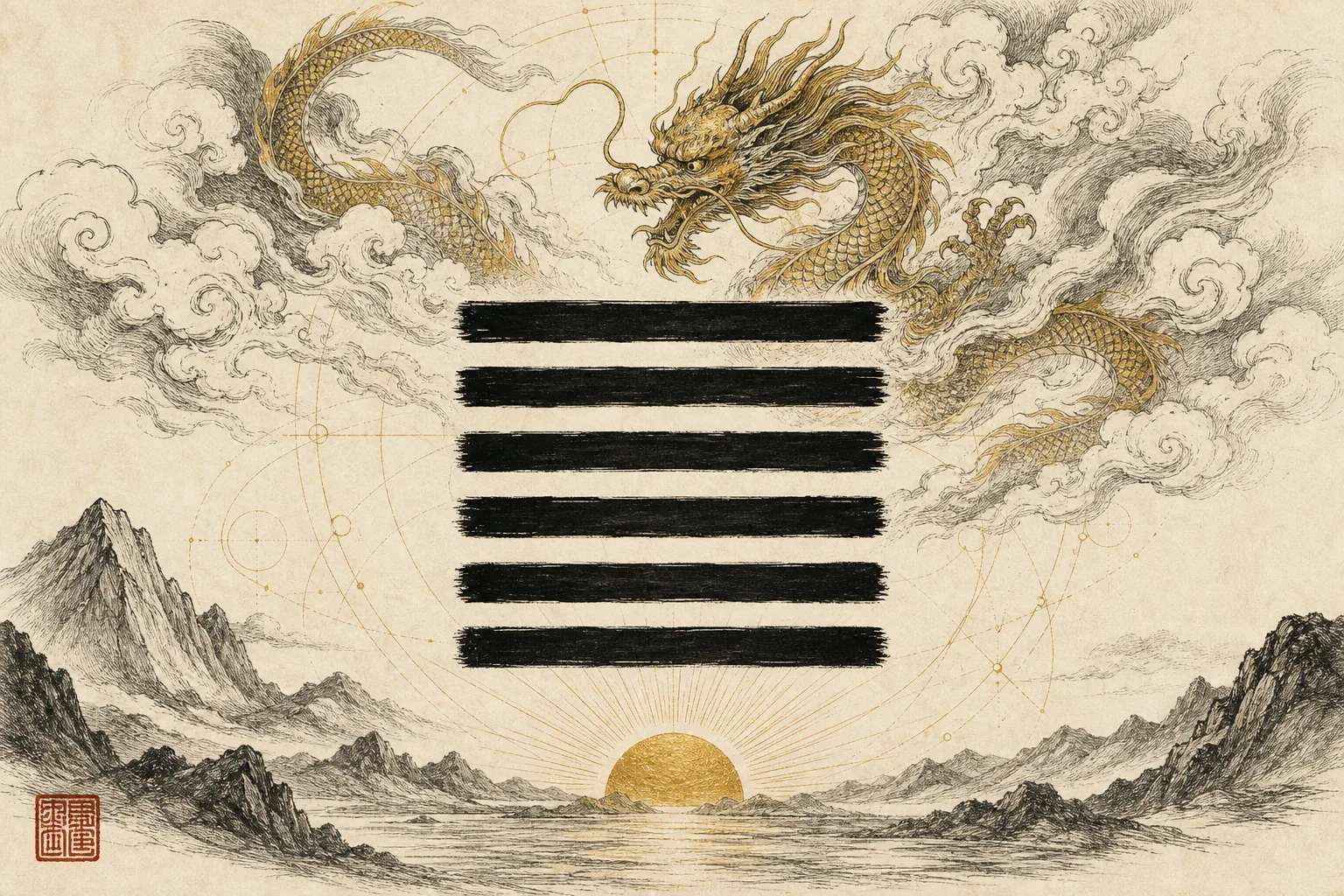
- Chinese
- 乾 ・ qián
- English
- The Creative
- Trigrams
- ☰ Heaven (above) over ☰ Heaven (below)
- Binary
- 111111 (decimal 63)
- Sequence
- 1 of 64 ・ next: 02. Kūn
What this hexagram is
The first hexagram of the I Ching is six unbroken yang lines — pure activating energy with no yin yet to receive or condition it. Where every other hexagram represents some interplay of forces, Qián is the pre-conditional state: the impulse before form, the spring before the river. For this reason it is called the Creative, and it sits at the head of the King Wen sequence as the source from which everything else proceeds.
To draw this hexagram is to be told: the situation is fundamentally favorable, you are at the start of something that has its own momentum, and your task is to align with that momentum without distorting it. The classical commentaries emphasize perseverance (貞, zhēn) — staying straight, staying patient, not asserting more than the current carries.
The judgment and the image
"The Creative works sublime success, furthering through perseverance."
乾、元亨利貞。
"The movement of heaven is full of power. Thus the superior man makes himself strong and untiring."
天行健、君子以自彊不息。
The four cardinal virtues named in the judgment — yuan (originating), heng (penetrating), li (furthering), zhen (persevering) — became, in the Confucian tradition, the standard description of a complete creative process. Whatever you are beginning under this hexagram should pass through all four: a true origin, a clear development, a benefit to the larger situation, and the persistence to see it through.
The dragon as the structuring image
Each of the six lines of Hexagram 1 references a dragon at a different stage of its life. This is the most poetic of the hexagrams, and the line texts read as a sustained meditation on the rise of creative power from concealment to peak to overreach. The Wilhelm/Baynes commentary follows this dragon imagery line by line; it is worth reading once straight through, even if your reading only includes one or two of the lines as changing.
The six lines
Nine in the first place
"Hidden dragon. Do not act." (潜龍勿用)
The dragon is still beneath the surface. The capacity is real but the time is not yet. Whatever you are beginning, do not announce it; do not commit publicly. The right action now is preparation, observation, the building of strength that nobody sees.
Nine in the second place
"Dragon appearing in the field. It furthers one to see the great man." (見龍在田、利見大人)
The dragon has emerged but is still close to the ground. You are visible, but in a junior position. The instruction is to seek a teacher, a mentor, or an authority who can recognize your nature and orient your work. To act independently now is premature.
Nine in the third place
"All day long the superior man is creatively active. At nightfall his mind is still beset with cares. Danger. No blame." (君子終日乾乾、夕惕若、厲、无咎)
A precarious middle position. The work is intense; the risks are real; the day does not end at sundown. The line counsels the discipline of staying vigilant even when tired. Done with that discipline, there is no fault — but the danger is genuine.
Nine in the fourth place
"Wavering flight over the depths. No blame." (或躍在淵、无咎)
A moment of choice — to leap into the higher position, or to remain in the depths a while longer. The line gives permission for either: there is no blame in waiting, and no blame in advancing. The right answer depends on inner readiness, which only you can assess.
Nine in the fifth place
"Flying dragon in the heavens. It furthers one to see the great man." (飛龍在天、利見大人)
The classical "ruler position" of the hexagram — the dragon at the height of its power. This is the line of mature, effective leadership. The accompanying advice is, paradoxically, to remain available to wise counsel: even at the peak, one consults the great person. Power that closes itself off from advice becomes the next line.
Nine at the top
"Arrogant dragon will have cause to repent." (亢龍有悔)
The dragon has flown too high. Power without humility becomes its own undoing. This is the hexagram's warning to those who have already arrived: the same energy that elevated you, if not tempered, becomes the energy of your fall. The remedy is to step back, to recognize the limit, to allow others their turn.
All nines (extremely rare)
"There appears a flight of dragons without heads. Good fortune." (群龍无首、吉)
If all six lines come up as 9, every line changes, and the hexagram becomes Hexagram 2, the Receptive. This is one of the I Ching's two special cases (the other is all sixes in Hexagram 2). The instruction is: complete creative power, when it does not insist on a head, becomes harmonious cooperation. The line praises leadership that does not need to be seen leading.
How to read Qián in your reading
If you have cast Qián with no changing lines, the situation is one of basic favorability — but not effortless success. The work is to remain straight (the meaning of 貞) and to persist. Do not interpret this as a guarantee; interpret it as permission and as a description of the current quality of the underlying conditions.
If you have changing lines, read each line text above in the position it occupies. The line texts often describe a specific stage of a creative project; the line in your reading is pointing to which stage you are actually at. The Wilhelm/Baynes edition has more detailed commentary on each line; this article gives the kernel.
If your changing lines convert Qián into another hexagram, that resulting hexagram describes where the creative energy is going. Pay attention to which of the original yang lines turned to yin: those are the points where, in your situation, force needs to give way to receptivity.
Common questions answered by Hexagram 1
- "Should I start this project / business / relationship?" — Yes, the underlying conditions are favorable. Begin, but with proper preparation (line 1) and humility about your current stage.
- "Am I ready to take on this leadership role?" — Possibly, but consult the line. Line 5 is full readiness; line 4 is the wavering decision; line 2 says find a teacher first.
- "Why is this not working faster?" — Hexagram 1 says perseverance. Speed is not what the hexagram promises; it promises sustained progress through proper effort.
- "Should I push harder?" — Read the top line carefully. Strength used past its proper limit becomes overreach. The hexagram gives you energy; it does not give you a license to ignore limits.
Cast and read your own hexagram
I Ching AI implements the traditional yarrow algorithm and presents your hexagram with the original Chinese, Wilhelm's German translation, the English Wilhelm-Baynes edition, and a complete Japanese rendering. An AI trained on 200,000+ characters of commentary helps you read the result in light of your specific situation.
Download I Ching AI