Hexagram 50 — Dǐng, The Cauldron
鼎 ・ Fire over Wind ・ The sacred vessel that transforms
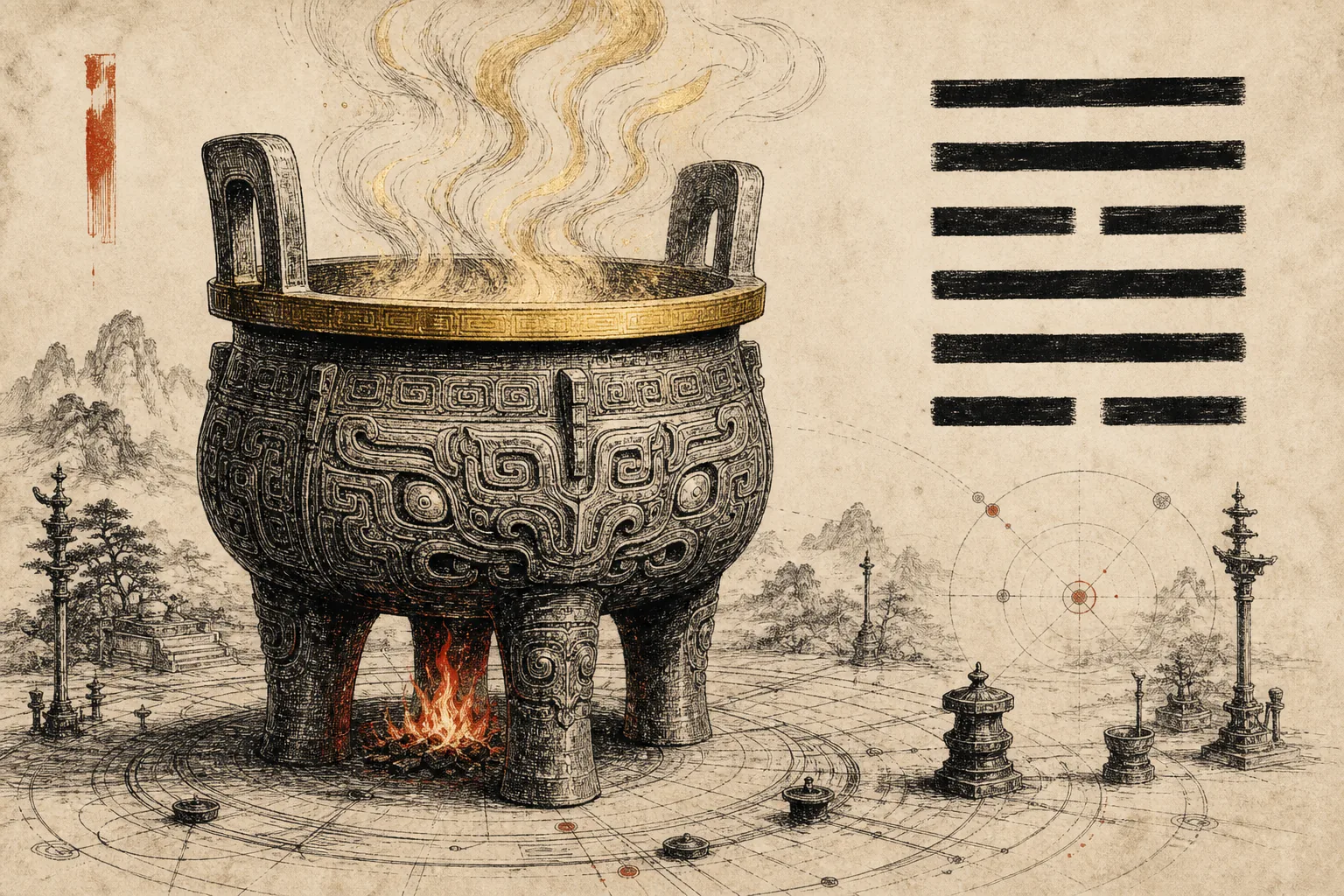
- Chinese
- 鼎 ・ dǐng
- English
- The Cauldron / The Sacred Vessel
- Trigrams
- ☲ Fire (above) over ☴ Wind / Wood (below)
- Binary
- 011101 (decimal 29)
- Sequence
- 50 of 64 ・ paired with 49 Gé (Revolution)
In 1949, while preparing to write the foreword to the Wilhelm/Baynes English I Ching, Carl Jung performed an experiment: he asked the I Ching itself what it thought of being translated for an American audience that had no living tradition for it. The hexagram he cast was Dǐng.
Jung wrote about this in the foreword — and the cauldron's image of "a ritual vessel that transforms physical nourishment into spiritual nourishment" struck him as a precise self-description of what the I Ching itself is. Full account in the Jung essay →
What this hexagram is
The cauldron — the dǐng — was the ritual instrument at the center of Bronze Age Chinese religion. A heavy three-legged bronze vessel, decorated with stylized animal masks, used to cook sacrificial offerings to ancestors and to the gods. To possess a dǐng was to possess legitimate political authority. The largest cauldrons stood at the gates of state ceremonies.
The hexagram takes this object and uses it as a model for any process that transforms raw material into something sacred or useful. The image is concrete: ingredients are placed in the vessel, fire is applied beneath, time passes, and what comes out is not what went in. Cooking, refining, teaching, translating, healing, raising a child — all of these are dǐng operations. The hexagram counsels attention to the vessel itself: its integrity, its proper placement, its cleanliness, the patience to let the heat do its work.
The judgment and the image
"The Cauldron. Supreme good fortune. Success."
鼎、元吉、亨。
"Fire over wood: the image of the Cauldron. Thus the superior man consolidates his fate by making his position correct."
木上有火、鼎、君子以正位凝命。
The judgment is unusually brief and unconditionally favorable — one of the few hexagrams that opens with "supreme good fortune" without immediate caveat. The image grounds this favorability in a particular discipline: 正位 (zhèng wèi, "making one's position correct"). The cauldron's power depends entirely on its being set up in the right place, on level ground, with the legs balanced. The hexagram's promise is conditional on this care for placement.
The six lines as the cauldron's life
The line texts of Dǐng follow the cauldron as a physical object, from upside down to in use to passed on. Reading the six lines in sequence is reading the life cycle of the vessel itself — which is a deliberate parallel to the life cycle of whatever you, the consultant, are working on.
The six lines
Six in the first place
"A cauldron with legs upturned. Furthers removal of stagnating stuff. One takes a concubine for the sake of her son. No blame." (鼎顛趾、利出否、得妾以其子、无咎)
An unconventional beginning. The cauldron tipped over is normally undignified, but here it is what allows the old residue to fall out. The line counsels accepting an apparent indignity early in a process if it clears the way for what comes next. The cryptic mention of taking a concubine "for the sake of her son" is the same principle: unconventional means, legitimate end.
Nine in the second place
"There is food in the cauldron. My comrades are envious, but they cannot harm me. Good fortune." (鼎有實、我仇有疾、不我能即、吉)
This is one of the two lines Jung specifically read in his 1949 cast. The cauldron is full; envy gathers around the one who has been entrusted with substantive work. The line says: the envy is real, but it cannot reach you. Continue the work; do not be distracted by what others say of it.
Nine in the third place
"The handle of the cauldron is altered. One is impeded in his way of life. The fat of the pheasant is not eaten. Once rain falls, remorse is spent. Good fortune comes in the end." (鼎耳革、其行塞、雉膏不食、方雨虧悔、終吉)
The second of Jung's two changing lines. The cauldron's handle has become deformed — the means of moving the work forward is no longer working properly. Food sits unconsumed; energy is stuck. The line predicts that the impasse will break — "once rain falls" — and that good fortune comes in the end. But it requires patience while the structural impediment resolves itself.
Nine in the fourth place
"The legs of the cauldron are broken. The prince's meal is spilled, and his person is soiled. Misfortune." (鼎折足、覆公餗、其形渥、凶)
A serious warning. The cauldron has collapsed because its legs (its foundation, its supports) could not bear the load. The prince's meal — the work in progress — is ruined. This is what happens when one is given a task too large for one's current capacity and does not say so in time. The line counsels honesty about what one can actually carry.
Six in the fifth place
"The cauldron has yellow handles and golden carrying rings. Perseverance furthers." (鼎黃耳金鉉、利貞)
The ruler position. The vessel is properly equipped — yellow handles (the color of the center, of moderation) and golden carrying rings (sound and durable means of conveyance). The line praises the leadership that has gotten the structure right. The recommendation is to persist in this configuration; do not redesign what is already working.
Nine at the top
"The cauldron has jade rings. Great good fortune. Nothing that would not act to further." (鼎玉鉉、大吉、无不利)
The hexagram closes with the highest possible praise — jade carrying rings. Jade in classical Chinese symbolism is the perfect material: cool, hard, virtuous, never aging. The vessel that has reached this stage is fit not only for use but for transmission. The line points to the moment when a work, properly completed, can be passed on intact to the next generation.
How to read Dǐng in your reading
If you have cast Dǐng with no changing lines, the situation is overwhelmingly favorable, but this favorability depends on getting the foundation right — the cauldron's placement. Whatever you are working on, before you proceed, ensure the basics are in order: the right people are in the right roles, the structure has solid legs, the materials are clean. The promise of supreme good fortune is conditional on this care for the vessel.
If you have changing lines, read each line text in position. The cauldron's life cycle maps cleanly onto most projects: line 1 is messy beginnings, line 2 is being entrusted with real substance, line 3 is the inevitable impasse, line 4 is overload, line 5 is mature execution, line 6 is graceful conclusion. Whichever line is changing for you, it is telling you which stage of the cauldron's life your situation actually occupies.
Common questions answered by Hexagram 50
- "Will this creative / spiritual / pedagogical project succeed?" — The fundamental answer is yes, with the qualification that the structure must be correct. Pay attention to who is in the work, not just to the work itself.
- "My work is stuck right now — what does this mean?" — If your changing line is in the third position, the I Ching is telling you that the impasse is expected, structural, and temporary. Wait for the rain.
- "Should I take on more than I can handle?" — Read line 4. The cauldron with broken legs is the answer. Do not accept loads that exceed your foundations.
- "How do I know when this work is complete?" — Line 6's image of jade rings is the test. When the work is fit not just for use but for being passed on intact, it is finished.
Cast and read your own hexagram
I Ching AI implements the traditional yarrow algorithm and presents your hexagram with the original Chinese, Wilhelm's German translation, the English Wilhelm-Baynes edition Jung wrote the foreword to, and a complete Japanese rendering. An AI trained on 200,000+ characters of commentary helps you read the result in light of your specific situation.
Download I Ching AI