Hellmut Wilhelm and the I Ching: Eight Lectures, Peking 1943
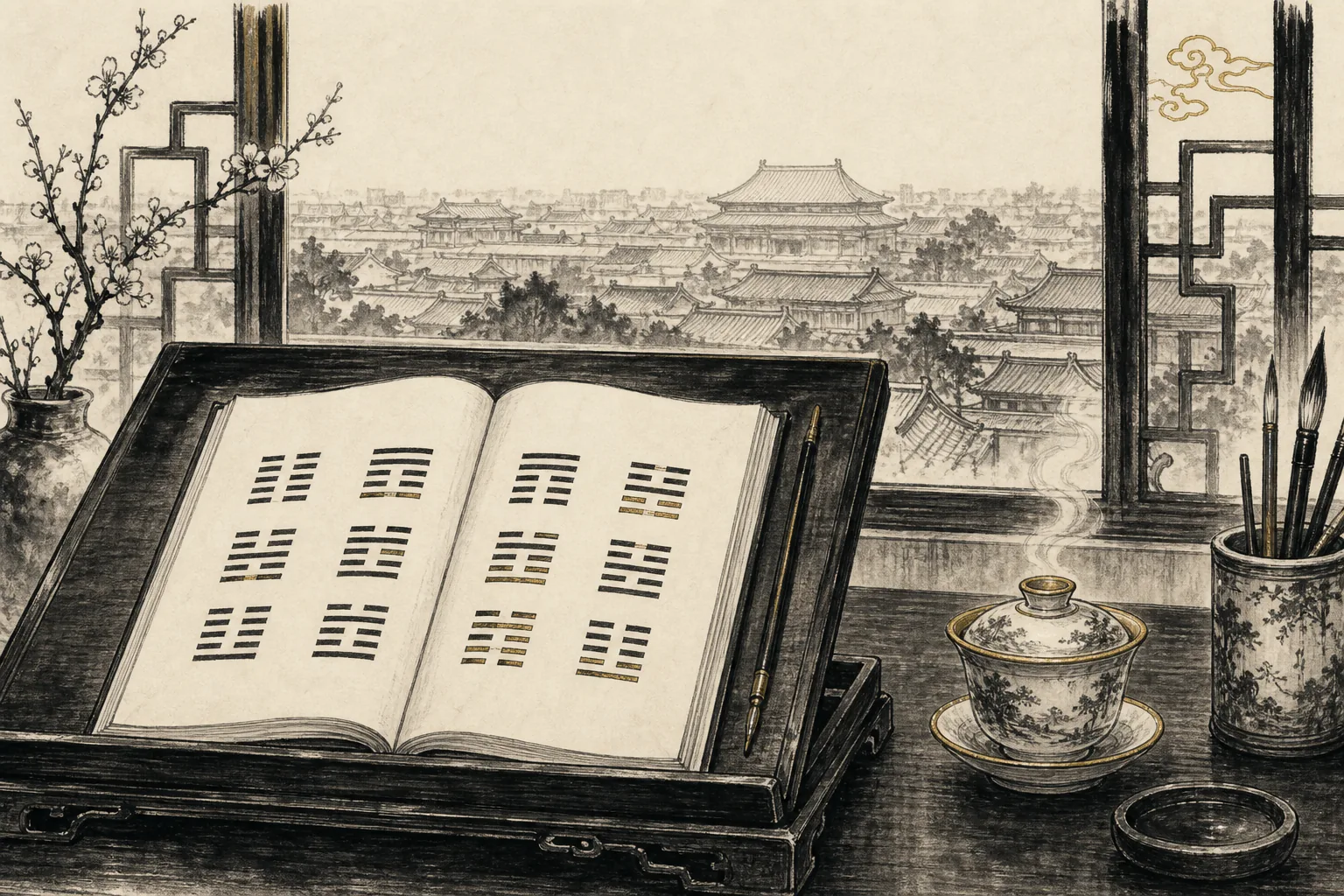
In the spring and summer of 1943, in Japanese-occupied Peking, a thirty-eight-year-old German sinologist named Hellmut Wilhelm delivered eight lectures on the I Ching at the China Institute. He was the son of Richard Wilhelm. The China Institute had been founded by his father in Frankfurt in 1925, and the lectures Hellmut gave in Peking were, in a precise sense, a continuation of his father's work. They were published in Chinese in 1944 and in English in 1960 as Change: Eight Lectures on the I Ching. They remain the most important post-Wilhelm secondary source on the book in any Western language.
An inherited project
Hellmut Wilhelm was born in 1905 in Tsingtao, in the German concession on the Shandong coast — the same city where his father had been working for six years as a missionary and was just beginning to study Chinese under Lao Naixuan. He spent his early childhood there. Chinese was, in the most literal sense, his second language; he learned it as the language of the streets and the servants while his father translated the classics upstairs.
When the family returned to Germany in 1921, Hellmut continued his Chinese studies at the Universities of Berlin and Hamburg, taking his doctorate in 1932. He returned to China in 1935, took up a teaching position at Peking University, and remained in China through the Japanese occupation, the World War, the early postwar period, and the eve of the Communist victory. He left in 1948 and accepted a chair at the University of Washington in Seattle, where he taught for the next thirty-three years.
Peking, 1943
The conditions under which Hellmut Wilhelm delivered the eight lectures were extraordinary. Japanese forces had occupied Peking since 1937. Foreign nationals in the city lived in a precarious accommodation with the occupying authorities — some interned, some allowed limited movement, all monitored. The China Institute, which Hellmut had been involved with for years, had become a small, semi-clandestine center for German-language intellectual life in the city.
The audience for the eight lectures was not the general public. It was a small circle of German-speaking intellectuals — sinologists, diplomats, missionaries, refugees — who had remained in Peking through the war. Hellmut gave the lectures in German. They were promptly translated into Chinese by a Chinese colleague and circulated in Chinese intellectual circles in occupied Peking. The original German manuscript was preserved through the war and published, after the lectures had reached audiences in Europe and America through their Chinese translations, as Die Wandlung: Acht Vorträge zum I Ging (1944).
The eight lectures
The eight lectures cover, in order: the origins and dating of the I Ching; the structure of hexagrams and the meaning of the trigrams; the relationship between the trigrams and the eight natural images; the doctrine of change; the use of the I Ching as a divinatory instrument; the philosophy implicit in the system; the ethical applications of the hexagrams; and the place of the I Ching in Chinese thought.
What makes the lectures distinctive is their double audience. They are addressed to readers who do not necessarily know classical Chinese, and they assume no prior familiarity with the I Ching's technical vocabulary. At the same time, they are written with full philological rigor — Hellmut had read every major Chinese commentary tradition and could place his father's Wilhelm/Baynes translation within the full scholarly landscape that produced it.
"The I Ching is not a closed system. It is an open system, in the precise sense that its sixty-four configurations are not exhaustive of the situations it describes but rather form a grammar for generating descriptions of situations. The grammar is finite; the situations the grammar can describe are not."
— Hellmut Wilhelm, Change: Eight Lectures on the I Ching (paraphrase)
This framing — the I Ching as a generative grammar rather than a closed dictionary — became influential. It allowed the book to be taken seriously by readers who would not have accepted its claims on traditional terms but who could recognize, in the description of a finite combinatorial system that produced infinite specific readings, something that resembled both mathematical structure and linguistic competence.
Postwar career at Washington
Hellmut Wilhelm joined the University of Washington in 1948 and remained there until his retirement in 1971. He trained a generation of American sinologists, contributed substantial articles to scholarly journals (the most important collected in Change: Eight Lectures and in Heaven, Earth, and Man in the Book of Changes), and served as one of the main intellectual links between his father's generation of German-trained sinologists and the American academic Chinese studies that emerged after the war.
He also served on the editorial board of the Bollingen Foundation, the institution that had published the English Wilhelm/Baynes I Ching with Jung's foreword in 1950. Hellmut was directly involved in the production of that English edition, ensuring it remained faithful to his father's intentions while making editorial decisions that were necessary for an English-language scholarly publication. The Wilhelm/Baynes I Ching that has been in print continuously since 1950 is, in significant measure, a father-son collaboration spanning two generations and three languages.
Heaven, Earth, and Man
Hellmut Wilhelm's other major work on the I Ching is Heaven, Earth, and Man in the Book of Changes, published by University of Washington Press in 1977. The title comes from one of the classical Chinese formulations of the three planes of reality the I Ching addresses: the cosmological, the natural, and the human. The book is a series of essays, more technical than Eight Lectures, on specific structural features of the I Ching — the doctrine of the changing lines, the relationships between paired hexagrams, the role of the Ten Wings in transforming the book from divination manual into philosophical canon.
It is in Heaven, Earth, and Man that Hellmut develops his most precise philological treatment of the relationship between the original Zhou-dynasty hexagram texts and the much later Confucian commentaries. His position is that the two strata are genuinely different in age and intellectual character, but that the Confucian reading is not a misreading — it is a development of patterns already implicit in the original text.
Legacy
If Richard Wilhelm gave the modern West its I Ching, Hellmut Wilhelm gave the modern Western academy its I Ching. His Eight Lectures remains the standard graduate-level introduction in English. His Heaven, Earth, and Man is the standard secondary scholarly reference. The continuous in-print history of the Wilhelm/Baynes translation — with Jung's foreword, Hellmut's editorial work, and the Bollingen Foundation's institutional support — is in large part the Wilhelm family's two-generation achievement.
That a single family across two generations produced both the most important Western translation of the I Ching and the most important Western scholarly framework for reading it is, by itself, a small miracle of intellectual transmission. Richard learned from Lao Naixuan; Hellmut learned from Richard; the Western world learned from both. The Wilhelm tradition is, very precisely, what it is because of this lineage.
Read the I Ching the Wilhelms taught the West to read
I Ching AI includes the full Wilhelm/Baynes English edition that Hellmut helped prepare for Bollingen, alongside the original Chinese, Wilhelm's German translation, and a complete Japanese rendering. An AI trained on 200,000+ characters of commentary helps you read each hexagram in the framework two generations of Wilhelms established.
Download I Ching AI