John Cage and the I Ching: Chance Operations and Music of Changes
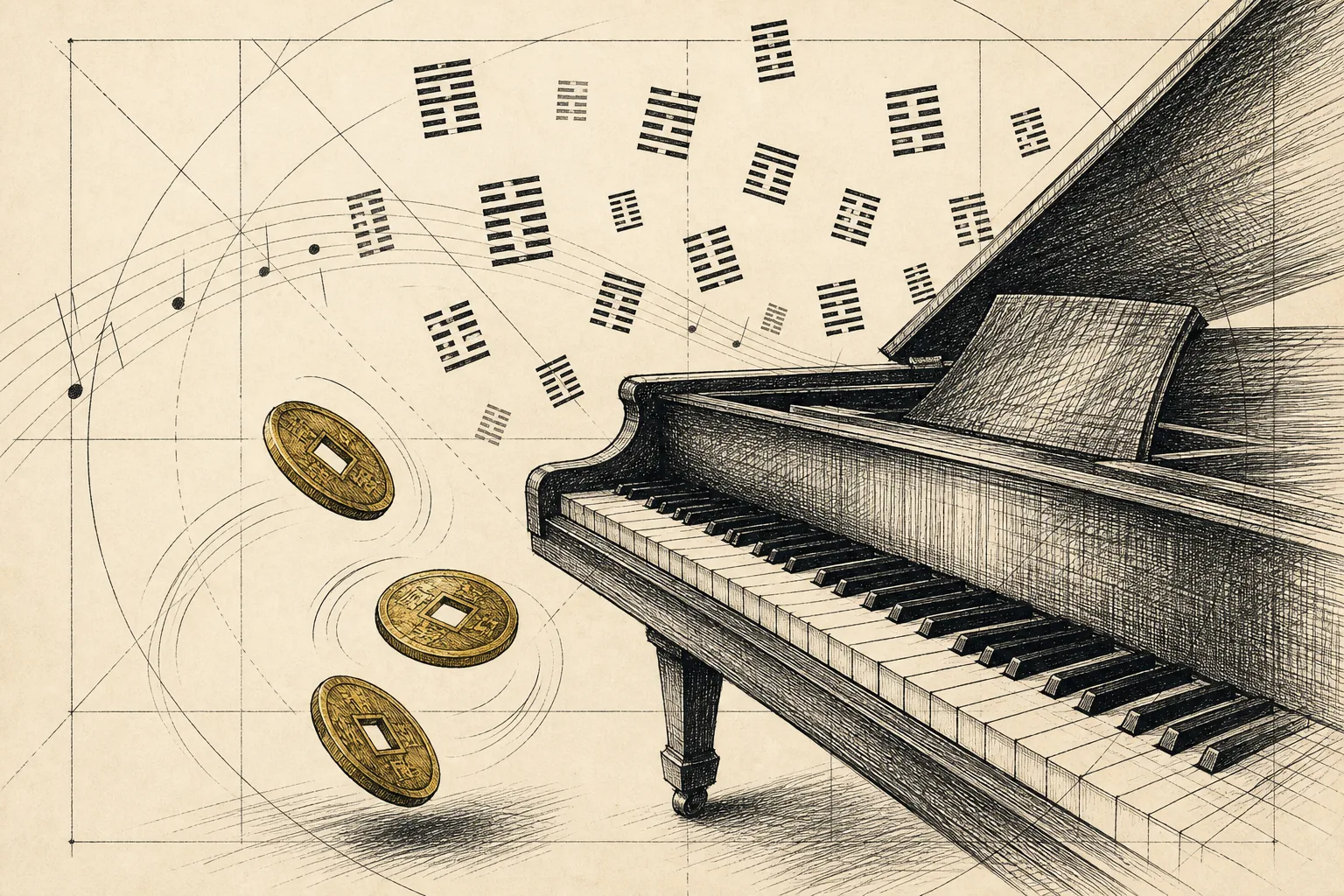
In the spring of 1951, the pianist David Tudor sat at a keyboard in New York and gave the first performance of a 43-minute work whose every note, every duration, every dynamic, every tempo, and every silence had been determined not by John Cage but by the 64 hexagrams of the I Ching. The piece is called Music of Changes. It changed twentieth-century music.
A lecture at Columbia, 1949
John Cage was already in his late thirties when he sat in on a series of lectures by Daisetsu Teitarō Suzuki at Columbia University in the late 1940s. The Suzuki who would later be called "the man who brought Zen to America" was, at that point, an aging Japanese scholar working through ideas of mushin ("no-mind") and ji-ji muge ("the interpenetration of particulars"). Cage attended for several years, and by his own later account, the encounter remade him.
What Cage was looking for, before Suzuki, was already in motion. He had grown disenchanted with the personal-expression model of mid-century American composition — the idea that the composer's task was to communicate their emotional state. He wanted to write music that did not have a self in the middle of it. The problem was practical: if you remove the composer's taste, what makes the decisions?
The gift from Christian Wolff
The answer arrived in the form of a book. In 1950, the young composer Christian Wolff — then sixteen years old, a student of Cage's — gave him a two-volume copy of the Wilhelm/Baynes English I Ching, published that year by Bollingen. Wolff's father, Kurt Wolff, was the founder of Pantheon Books, the Bollingen Foundation's American imprint. Christian thought Cage would find the book interesting.
Cage opened it and, almost immediately, saw the answer to his problem. The I Ching already had a procedure for generating one of 64 outcomes from a chance event (three coins, six times). What if those 64 outcomes were not hexagrams but musical parameters — pitches, durations, amplitudes? You would have a way of making music in which the composer chose the system but not the notes.
Within months, Cage had set up a series of charts. Each of the 64 cells in his charts contained a musical element — a sound, a silence, a duration, a dynamic. To compose, he tossed three coins six times to generate a hexagram, then read off whatever the corresponding cell contained.
How Music of Changes was made
Music of Changes, composed across 1951, was the first major piece written this way. Cage prepared elaborate charts: one for sounds (including silences), one for durations, one for dynamics, and one for tempo. Each chart was an eight-by-eight grid of 64 cells. The piece was built section by section. For each event, Cage tossed coins, derived a hexagram, and read what each chart told him.
The result was a piece that no one — including Cage — had decided. Its harmonies are unrelated to traditional harmony. Its rhythms do not pulse. Its dynamics swing without preparation from ppp to fff. The pianist's job is brutal: precise execution of decisions that came from outside the room.
"I use chance operations instead of operating according to my likes and dislikes. I use my work to change myself and I accept what the chance operations give. I have no further desire."
— John Cage, "Composition as Process" (1958)
The same year as Music of Changes, Cage composed Imaginary Landscape No. 4 for twelve radios — two performers per radio, one tuning, one controlling volume — with all settings derived from the I Ching. The premiere was famously inaudible; many of the radios picked up almost nothing at the late hour. Cage accepted the result without complaint. That, too, was what the hexagrams had specified.
Why Cage wanted to remove himself
It is easy to read Cage's chance operations as a stunt or as a refusal of craft. They were neither. Cage's argument, repeated throughout his lectures and essays, was that the composer's taste is a filter that reduces the music to what the composer already wanted. By substituting a chance procedure for taste, the composer encounters sounds that would never have been chosen — sounds that are, in Cage's word, found.
This is structurally close to what the I Ching does for an ordinary consultant. When you cast a hexagram about a question, you are deliberately stepping outside your own reasoning. The hexagram you receive is, by definition, not what you were going to do. The work then is to read it and absorb it.
Cage applied this principle as composition. He treated the resulting music the same way a careful consultant treats a difficult hexagram: as a configuration to be lived with rather than judged. "Everything we do," he wrote, "is music." The I Ching gave him the procedural authority to mean it.
From coin tosses to a computer program
By the early 1980s, Cage's compositional practice depended on so many I Ching consultations that the labor of tossing coins had become punishing. In 1984, his assistant Andrew Culver wrote a program — called simply IC — that simulated I Ching hexagrams on a Commodore 64. Cage used it for the remainder of his life.
The translation matters. Cage did not consider IC a shortcut or a betrayal of the procedure. The 64 outcomes of the program were drawn from the same distribution as the coins; what mattered was the procedure, not the implementation. A digital random-number generator was, for Cage, no less an oracle than a fistful of yarrow stalks — provided the question was real and the procedure was followed exactly.
This is worth noting, because the same logic applies to any contemporary digital implementation of the I Ching. The hexagram's claim on you does not depend on whether it came from biological probability (yarrow stalks), mechanical probability (coins), or computational probability (an app). It depends on whether you took the question seriously.
The legacy
The line of descent from Music of Changes is dense and unmistakable. Indeterminacy in classical music — Christian Wolff, Earle Brown, Morton Feldman in their experimental phase — comes from Cage. The aleatoric procedures of European composers like Pierre Boulez and Karlheinz Stockhausen come, in part, from Cage's challenge. Fluxus, conceptual art, the chance-based poetry of Jackson Mac Low — all of it traces back through Cage to the Wilhelm/Baynes I Ching that Christian Wolff handed him in 1950.
What Cage demonstrated, in the only way an artist can demonstrate anything, is that the I Ching is not merely a divination tool. It is a procedure for stepping outside one's own preferences. Once you have such a procedure, you can use it for choosing notes, for choosing words, for choosing a course of action in a difficult negotiation. The form of the answer changes; the structure of the method does not.
The same I Ching Cage consulted, now on your phone
I Ching AI includes the Wilhelm/Baynes English edition Cage used, alongside the original Chinese, Wilhelm's German translation, and a full Japanese translation. An AI trained on 200,000+ characters of commentary helps you read the hexagram you receive — without filtering it through what you wanted to hear.
Download I Ching AI