Philip K. Dick and the I Ching: How an Oracle Wrote The Man in the High Castle
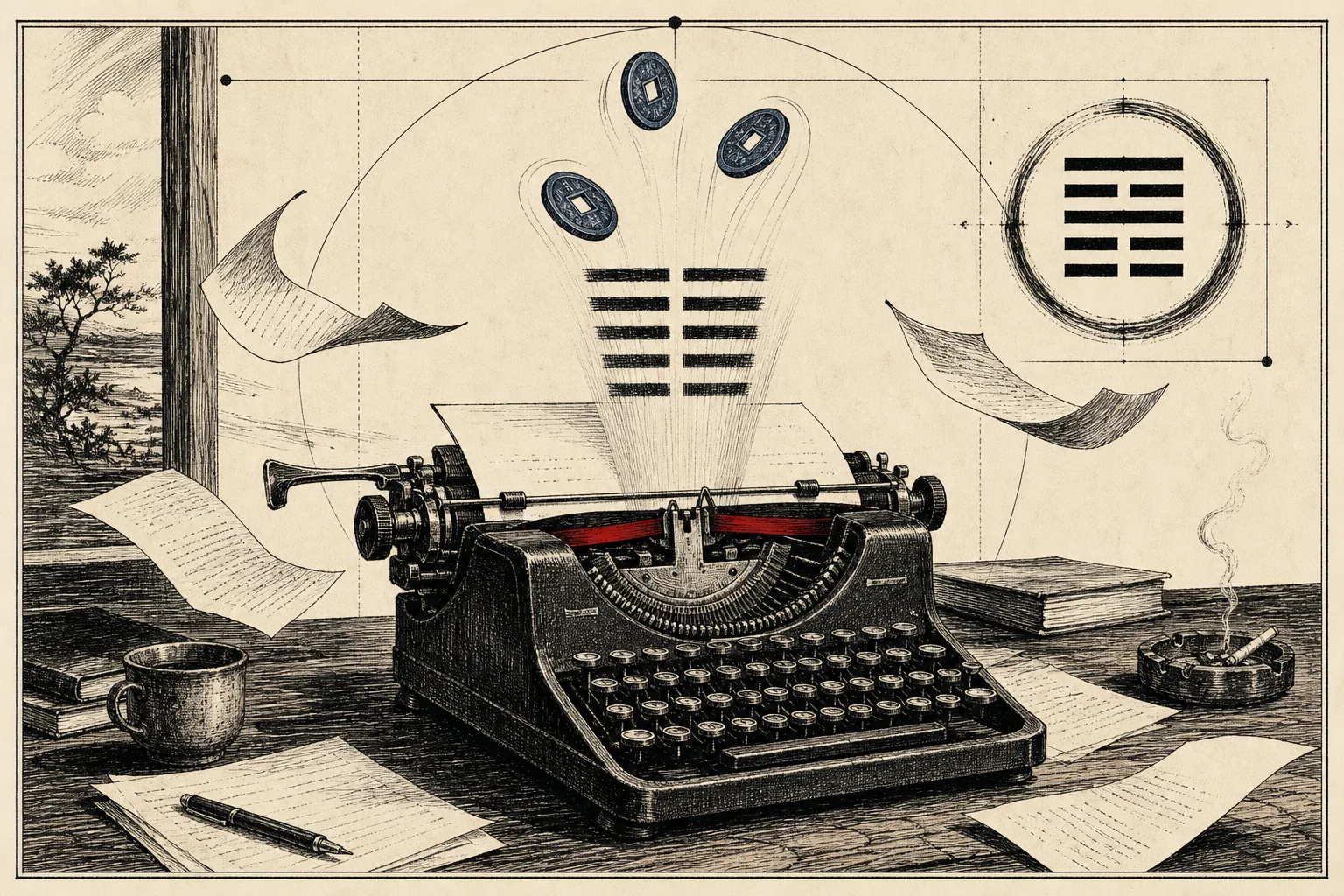
In 1961, working in a small house in Point Reyes Station, California, Philip K. Dick sat down each morning with a typewriter and a copy of the Wilhelm/Baynes I Ching on the desk beside him. When his characters reached a decision point — go left or go right, trust or distrust, accept or refuse — he set aside the manuscript, tossed three coins six times, and let the hexagram decide. The novel that emerged, The Man in the High Castle, won the 1963 Hugo Award and made him famous.
The method
Dick was not the first novelist to use chance procedures, and he was not the first American to read the I Ching. But he is the only major writer of the twentieth century who explicitly let an ancient oracle direct the plot of an entire prize-winning novel — and then said so, in interviews, repeatedly, for the rest of his life.
His procedure was direct. When a character's choice was unclear, Dick would frame the choice as a yes/no or A/B question and consult the I Ching. He used the three-coin method, casting six lines from bottom to top, exactly as Wilhelm's introduction instructed. He then read the resulting hexagram, including any changing lines, and let what the hexagram said determine what the character did.
Crucially, the consultations also shaped plot direction, not only character decisions. Dick has said in several interviews that when he was uncertain about which way to take the next chapter, he asked the oracle. If the answer was "Modesty" (Hexagram 15), one thread continued and another receded. If the answer was "Conflict" (Hexagram 6), the opposite. The book moved according to the casts.
A novel inside the novel
The structural cleverness — what makes The Man in the High Castle a permanent fixture in serious literature rather than a curiosity — is that the I Ching also appears inside the book. Set in an alternate-history America divided between Japan and Germany, the novel depicts characters who consult the I Ching exactly as Dick did, about questions exactly as urgent.
The trade attaché Nobusuke Tagomi consults it. The Jewish refugee craftsman Frank Frink consults it. Most importantly, the novelist Hawthorne Abendsen — author of a banned alternate-history novel within the novel called The Grasshopper Lies Heavy, in which the Allies won the war — has consulted it constantly while writing. At the climax of the book, Abendsen's wife reveals that the entire structure of The Grasshopper Lies Heavy was determined the same way: by tossing coins.
"One by one Hawth made the choices. Thousands of them. By means of the lines. Historic period. Subject. Characters. Plot. It took years."
— The Man in the High Castle, chapter 15
The reader, halfway through this scene, realizes that Abendsen has done what Dick did — and that the I Ching within the novel is doing exactly what the I Ching outside the novel was doing while Dick wrote it. The fictional and the actual collapse onto each other. This is the structural move that gives the novel its strange depth.
The hexagram that ended the book
The most famous consultation in the book is the last one. Toward the end, Tagomi casts the I Ching about the meaning of the entire situation he is in, and receives Hexagram 61, Chung Fu (Inner Truth). The Wilhelm commentary on this hexagram includes the observation that "even with pigs and fishes, good fortune" — that even unpromising material, approached with sincerity, can be illuminated by truth.
Dick has said that this hexagram came up when he cast about how the novel should end. He did not invent it; he asked, and Inner Truth was what the coins gave him. The interpretation he then wrote for Tagomi is, structurally, his own answer to his own question about the book. The novel ends inconclusively — Abendsen's casts suggest that, in the deepest sense, the Allies did win the war, and the alternate history we have been reading is, in some other layer, the false one. Inner truth bleeds through.
The result is a novel whose last move is to undermine its own premise. It is one of the great closing gestures in twentieth-century American fiction, and it was, by Dick's own account, given to him by Hexagram 61.
Dick's later regret
In interviews from the late 1970s, Dick spoke about the I Ching method with some ambivalence. The procedure had worked — magnificently — but it had also bound him. When the oracle gave a plot turn that didn't suit him, he had to accept it; otherwise the project's whole basis collapsed. He felt, by the end of The Man in the High Castle, that the oracle had become a co-author with veto power, and that the resulting book was not entirely his.
"I have to say one thing in candor: I used the I Ching as a research tool to write that novel," he said in a 1974 interview. "I was using it as a way of finding out what the plot should be. And it gave me bad plot ideas as well as good ones. So I came to disrespect it." The disrespect was the disrespect of an artist for a tool that had, occasionally, given him bad sentences. It was not a denial of what the tool had given him.
He did not use the method for any subsequent novel in such a thorough way. But he kept the I Ching. It remained on his desk, and it appears again and again in the journals he later collected as the Exegesis.
The I Ching in the Exegesis
Dick's last decade was dominated by a sustained mystical experience that began in February 1974, and by the eight thousand pages of philosophical journal he wrote trying to understand it. These journals — published posthumously as The Exegesis of Philip K. Dick — return to the I Ching repeatedly.
What is striking in the Exegesis is that Dick treats the hexagrams less as a writer's tool and more as a model of reality itself. The 64-fold structure of yin-yang combinations becomes, for him, a way of mapping the constantly shifting states of what he calls the Black Iron Prison and the Palm Tree Garden, the two interpenetrating realities he believes he glimpsed. The I Ching's premise — that any moment is a configuration of complementary forces, and that situations transform into other situations by lawful patterns — corresponds in his mind to the structure of the cosmos he is trying to describe.
This is the same move Jung had made twenty years earlier, on the steps of Wilhelm's German translation. Dick almost certainly came to it by way of Jung; the Bollingen edition Wilhelm/Baynes was one of the books on his shelf. But Dick takes it further: where Jung said the I Ching describes a kind of acausal relation, Dick suggests the I Ching's structure is the structure of reality.
This claim is too large to defend, and Dick knew it. But it is the natural extension of a writer who, twelve years earlier, had let the book write a novel.
The I Ching Dick used, on your phone
I Ching AI includes the same Wilhelm/Baynes English edition that sat on Philip K. Dick's desk, alongside the original Chinese, Wilhelm's German translation, and a full Japanese rendering. An AI trained on 200,000+ characters of commentary helps you cast and read hexagrams — for questions, for stories, for whatever you bring to it.
Download I Ching AI