Wolfgang Pauli and the I Ching: Synchronicity, the Pauli–Jung Letters, and Quantum Physics
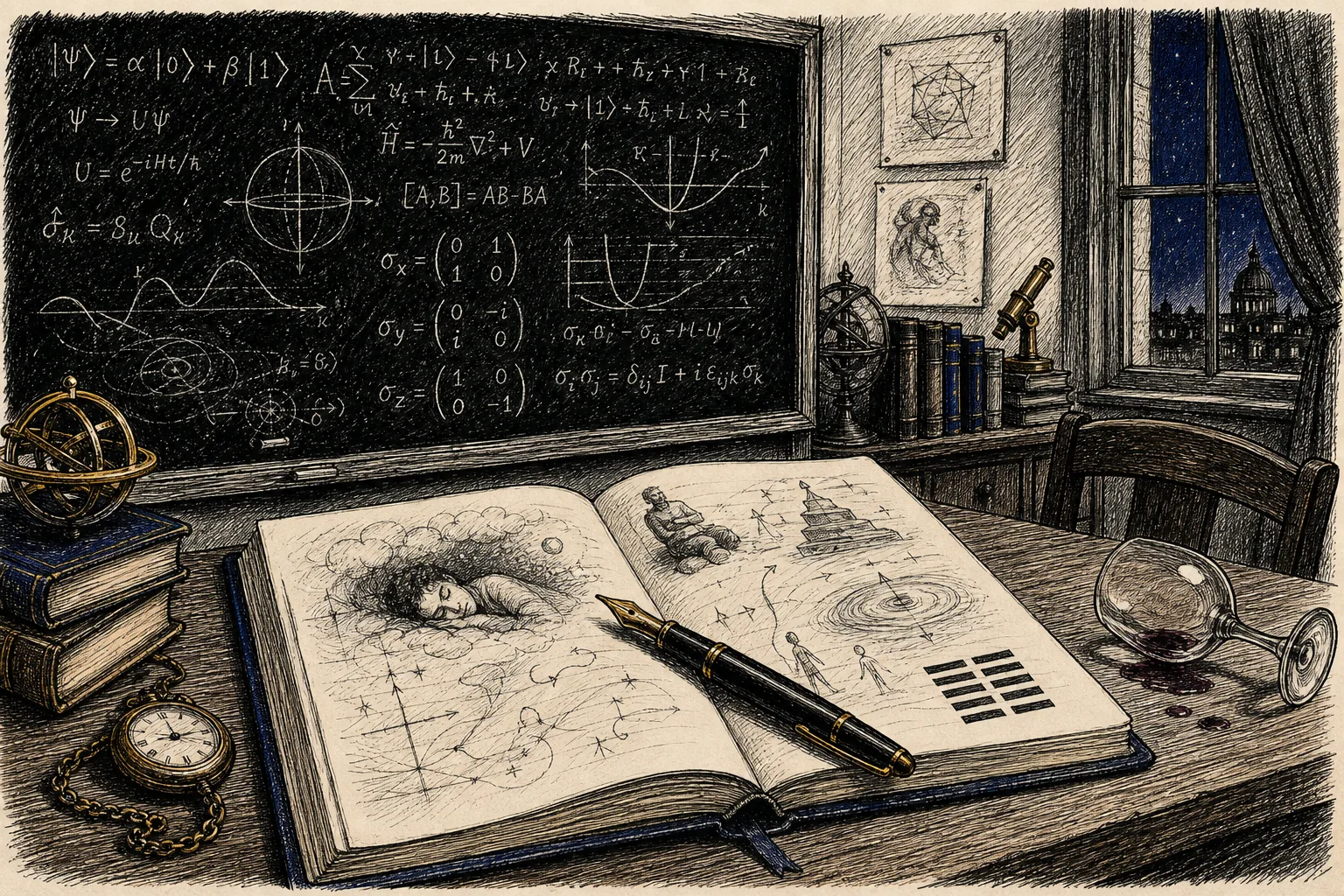
Wolfgang Pauli — Nobel laureate in physics for the exclusion principle, one of the small group who built quantum mechanics in the 1920s — spent the last two decades of his life as Carl Jung's most demanding interlocutor and the I Ching's most rigorous physicist-reader. The 1952 book the two of them co-authored, The Interpretation of Nature and the Psyche, is where Jung's theory of synchronicity was first published. The I Ching consultations that illustrate that theory were not Jung's alone; many of them were Pauli's, and Pauli pressed Jung on what they meant for nearly twenty-five years of correspondence.
1932: a personal crisis sends Pauli to Jung
By 1930, Pauli was thirty years old, a full professor at the ETH in Zurich, and the most feared theoretical physicist of his generation — known for the lacerating remark and the published proof. He was also in a marriage that was collapsing, drinking heavily, and showing every sign of a serious psychological crisis. In early 1932, on the advice of a friend, he asked for an appointment with Carl Jung. Jung, recognizing that Pauli was too intellectually formidable for a normal analysis, referred him to one of his pupils, Erna Rosenbaum, with whom Pauli worked for several years.
What followed is one of the most documented analyses in the history of psychoanalysis. Pauli kept extensive notes on his dreams; Jung used a selection of them (anonymized) as the empirical core of his book Psychology and Alchemy (1944). The "physicist" whose dream series Jung analyzes there is Pauli.
The relationship with Jung continued by letter for the rest of Pauli's life. Pauli sent Jung dreams, reflections on physics, accounts of his own I Ching consultations. Jung responded with interpretations and with questions of his own about quantum mechanics. The exchange was unprecedented — a serious scientist and a serious depth psychologist treating each other's domains with full intellectual respect.
The Pauli–Jung letters
The published correspondence (released as Atom and Archetype in 2001) covers 1932 to 1958 and contains explicit, extended discussions of the I Ching. Pauli used the book personally for questions about his health, his marriage, his physics, his philosophical doubts. He reported the results to Jung and asked, repeatedly and pointedly, what the hexagrams could possibly mean from a physical-causal standpoint.
Pauli was not naive about the methodological problem. He understood, better than almost anyone, that the I Ching's procedure could not be causally efficacious in the sense that physics uses the word. And yet, with the same regularity Jung had been observing for thirty years, the hexagrams kept being relevant. Pauli's letters are an attempt to think this through honestly.
"The result of an I Ching consultation appears to me to lie in a region of reality where ordinary distinctions between subject and object, between psychic and physical, are no longer entirely valid. I cannot dismiss what happens; I also cannot make it fit our current physical models."
— Pauli to Jung, 1950 (paraphrase, from Atom and Archetype)
This is not the position of a man who has surrendered his physics. It is the position of a man who has noticed an empirical anomaly and is unwilling to either suppress it or explain it away.
The 1952 book and synchronicity
Naturerklärung und Psyche — The Interpretation of Nature and the Psyche in the English edition published by Bollingen in 1955 — contains two long essays. Jung's contribution, "Synchronicity: An Acausal Connecting Principle," is the original publication of the synchronicity theory. Pauli's contribution, "The Influence of Archetypal Ideas on the Scientific Theories of Kepler," is a long essay on how the discovery of the laws of planetary motion was structured by Kepler's quasi-mystical conviction that the cosmos must be intelligible by archetypal patterns.
The two essays appear together for a reason. Jung is arguing that meaningful coincidences (synchronicities) — including the surprising aptness of I Ching consultations — are evidence of an acausal connecting principle in nature, distinct from but complementary to causality. Pauli is arguing that even the founding insights of modern physics emerged from archetypal patterns in the mind of a particular scientist. The two essays describe the same territory from opposite sides.
Pauli's role in shaping Jung's synchronicity essay was significant. The drafts had circulated between them for years; Pauli had pushed back, demanded precision, insisted that the concept be defined carefully enough to survive contact with physics. The version of synchronicity that appears in 1952 is more rigorous than the version Jung had been working with privately — and the rigor is in part Pauli's contribution.
Pauli's Kepler essay
Pauli's Kepler essay is the more philosophically careful of the two contributions. He shows that Kepler's discovery of his three laws of planetary motion was not the cool empirical procedure modern textbooks present. Kepler's notebooks reveal a mind committed to specific archetypal patterns — the polyhedra of Plato's Timaeus, the harmonic ratios of music, the Christian trinity — and bending the data, sometimes painfully, until it fit the patterns.
The patterns turned out to be partly right. The three laws of planetary motion are the laws of planetary motion. But the path to them ran through symbolic and mathematical archetypes that Pauli reads as analogous to the archetypes Jung had identified in his patients' dreams.
The implication, for our purposes, is direct. If even modern physics emerged in part from archetypal patterning in a particular scientist's mind, then the I Ching's use of patterning to organize human thinking about real situations is not an exotic alternative to physics. It is, in a precise sense, the same kind of operation conducted in a different domain. The Pauli–Jung synthesis treats archetype, synchronicity, and the I Ching as parts of a single inquiry into how minds and worlds correspond.
The "Pauli effect" and the question of meaning
Among physicists, Pauli was famous for the "Pauli effect" — a running joke that laboratory equipment broke when Pauli entered the room. Distinguished apparatus was said to have suffered inexplicable failures in his presence. Pauli himself, who appreciated a good joke at his own expense, treated this as a comic motif. Jung, on the other hand, was interested.
Jung treated the Pauli effect as a possible synchronicity — a class of events too rare and too pointed to be entirely chance, but not causally explicable by any current physical theory. Pauli was honest enough to admit that he didn't know whether the effect was a real anomaly or a statistical artifact reinforced by selective memory. What he insisted on, in his letters to Jung, was that the question was a serious one, and that the I Ching, by repeatedly producing similarly pointed results, was generating exactly the same kind of question.
A physicist's I Ching
Pauli died in December 1958, age fifty-eight, of pancreatic cancer. By that point he had been using the I Ching for over two decades, corresponding with Jung for nearly that long, and producing some of the most careful philosophical writing about science of any major physicist of his generation.
His engagement with the I Ching is important not because he was uncritical — he was famously critical of everything — but because he was not. A man who could write the exclusion principle could not be charmed by an oracle book. What Pauli found in the I Ching was something his physics had not foreclosed: a class of meaningful events that did not fit causal explanation but did not therefore disappear. He spent twenty-five years thinking carefully about what this meant, and the result is one of the most honest treatments of the I Ching's epistemological status by any modern Western thinker.
The fact that the two essays in The Interpretation of Nature and the Psyche appear together — synchronicity from Jung, archetypal patterns in Kepler from Pauli — is the central document of the I Ching's twentieth-century intellectual history. Without Pauli, Jung's synchronicity theory would have been published as a depth psychologist's speculation. With Pauli's name on the same volume, it became a serious challenge that physics could not ignore.
Read the I Ching as Pauli read it — rigorously
I Ching AI includes the full Wilhelm/Baynes English edition Pauli used, alongside the original Chinese, Wilhelm's German translation, and a complete Japanese rendering. An AI trained on 200,000+ characters of commentary helps you read each hexagram with the kind of attention Pauli demanded.
Download I Ching AI